-
Q Does D&D Hardware provide technical documentation for project submittals?
A D&D Hardware provides complete technical documentation packages including: UL certification letters, ANSI/BHMA test reports, product specification sheets with dimensional drawings, material certifications, finish samples, and compliance letters formatted for project submittal requirements. Their technical team can also assist with specification writing and respond to architect RFIs (Requests for Information) regarding fire door hardware compliance.
-
Q Can D&D Hardware provide hinges with my company's branding?
A Yes. D&D Hardware offers comprehensive OEM and private label services including custom branding (laser engraving or stamping), private packaging design, custom finish colors, and documentation under your brand identity. This service is particularly valuable for door manufacturers and hardware distributors who want to offer UL certified hinges under their own brand while maintaining full certification traceability. The UL listing remains valid as the product itself is unchanged — only the external branding and packaging are customized.
-
Q What is D&D Hardware's minimum order quantity (MOQ)?
A D&D Hardware accommodates both project-based orders and ongoing supply partnerships. MOQ varies by product configuration and finish. For standard stainless steel finishes, MOQs are typically accessible for mid-size door manufacturers and distributors. Contact their sales team at sales@danddhardware.com with your specific size, material, and finish requirements for a detailed quotation including MOQ, lead time, and volume pricing tiers.
-
Q Should I choose 2 ball bearing or 4 ball bearing hinges?
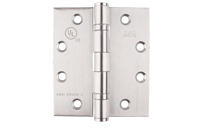
A The decision depends on door weight, traffic frequency, and additional hardware load. Four ball bearing (4BB) hinges are classified as heavy-duty and recommended for: doors exceeding 60 kg, high-frequency doors (hospitals, schools, retail), doors with automatic closers or access control devices, and oversized doors exceeding 1100mm width. Two ball bearing (2BB) hinges are standard weight and appropriate for moderate-traffic interior fire doors under 60 kg. Both configurations must carry UL 10C certification when installed on fire-rated assemblies.
-
Q What is the difference between UL fire rating and ANSI/BHMA mechanical rating?
A These are complementary but distinct certifications. UL fire rating (UL 10C) certifies that a hinge can withstand fire conditions for a specified duration and is required for fire-rated door assemblies. ANSI/BHMA rating (A156.1) certifies mechanical durability through accelerated cycle testing — Grade 1 requires 2,500,000 open/close cycles and Grade 2 requires 1,500,000 cycles. The ideal commercial fire door hinge carries both certifications: UL for fire code compliance and ANSI/BHMA for documented mechanical longevity. D&D Hardware's hinges hold both UL/cUL and ANSI/BHMA Grade 1 & Grade 2 certifications.
-
Q How do I verify if a manufacturer's UL listing is legitimate?
A Every legitimate UL listing can be verified through the UL Product iQ database at productiq.ulprospector.com. Request the manufacturer's UL File Number and search it directly. The database will show the listed company name, product categories covered, and certification details. For example, D&D Hardware's listing is verifiable under File No. R38013. If a supplier cannot provide a File Number, or if the number does not appear in the database, their UL claim should be considered unverified and potentially fraudulent.
-
Q What is UL 10C certification and why does it matter for door hinges?
A UL 10C is the Positive Pressure Fire Test standard administered by Underwriters Laboratories for door assemblies and their components. When a door hinge carries UL 10C certification, it has been independently tested under simulated fire conditions with positive pressure applied to the unexposed side of the door — replicating real fire dynamics. For D&D Hardware's hinges, this certification confirms that the hinge maintains the fire door's structural integrity for a full 3 hours (180 minutes) under these demanding conditions, preventing the passage of flame and hot gases through the door assembly. This certification is legally required by NFPA 80 for all hardware installed on fire-rated door assemblies in the United States.
-
Q Can D&D provide certification documents for project submissions?
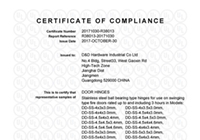
A Yes. We supply comprehensive certification packages including ANSI/BHMA test reports, UL fire rating certificates, BHMA listing documents, and detailed product specification sheets. Documentation can be customized for your project submission requirements upon request.
-
Q What is the minimum order quantity and lead time?
A D&D Hardware offers flexible ordering to accommodate projects of all scales. Popular models are maintained in stock for rapid dispatch, while custom configurations carry competitive production timelines. Contact our sales team for specific MOQ and delivery details tailored to your project scope.
-
Q How many lock functions are available?
A The range encompasses over 20 distinct functions — from basic passage (F01) and privacy (F02) to classroom (F05), storeroom (F07), corridor (F13), entrance (F20), and multiple deadbolt configurations. Every function shares the same universal lock case, enabling field-reversible handing without disassembly.
-
Q Can these locks be installed on both metal and wood doors?
A Absolutely. The locks conform to standard ANSI door preparations and are engineered for universal compatibility with hollow metal and solid wood doors. Whether you are specifying for a new construction project or retrofitting existing openings, no custom modifications are required.
-
Q What material is used for the lock body and trim?
A The lock case, face plate, strike plate, deadbolt, and latchbolt are all manufactured from SUS304 austenitic stainless steel — a premium alloy renowned for its exceptional corrosion resistance, mechanical strength, and longevity even in coastal or high-humidity environments.
-
Q Are these locks approved for fire-rated door assemblies?
A Yes. Every lock in this range carries UL 10C listing with a 3-hour fire endurance rating (UL File No. R40901). This ensures full compliance with fire door assembly requirements and applicable building codes. Complete UL certification documentation is provided with each shipment.
-
Q What does ANSI Grade 1 certification guarantee?
A ANSI Grade 1 represents the pinnacle of the ANSI/BHMA A156.13 standard. Locks bearing this certification have survived over one million operational cycles in laboratory testing, demonstrated maximum resistance to forced entry, and met the most stringent criteria for commercial deployment. This grade is typically mandated for hospitals, airports, government facilities, and other high-traffic environments.
-
Q How does a mortise lock differ from a cylindrical lock?
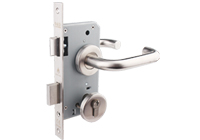
A A mortise lock is recessed into a rectangular pocket machined into the door edge, providing a substantially stronger mounting than cylindrical locks that rely on a single bored hole. This design delivers greater resistance to forced entry, supports multiple locking functions within one unit, and is the standard choice for commercial and institutional applications where longevity and security are non-negotiable.
-
Q How do I choose the right Euro mortise lock for my project?
A Consider these factors: (1) Door type — wooden, metal, or aluminium; (2) Door thickness and profile width; (3) Required function — entry/sash, privacy, emergency exit, passage, storeroom, or classroom; (4) Fire rating requirements per building code; (5) Backset size — 55mm, 60mm, or 65mm; (6) Cylinder type — single, double, or thumbturn; (7) For narrow-profile doors, choose our 30mm/35mm narrow stile range; (8) For sliding doors, select hook bolt locks. Contact sales@danddhardware.com for personalized technical recommendations based on your specific project requirements.
-
Q What materials are used in D&D Hardware Euro mortise locks?
A All critical components — forend plates, strike plates, latchbolts, and deadbolts — are manufactured from SUS304 austenitic stainless steel, providing exceptional corrosion resistance verified through 240-hour salt spray testing (EN 1670). Lock cases feature zinc-plated steel for additional environmental protection. Narrow stile variants are available in both SUS304 stainless steel and brass options. Specialty deadlock kits use 5-ply or 8-ply laminated steel with hardened roller pins for maximum attack resistance.
-
Q What types of Euro mortise locks does D&D Hardware offer?
A D&D Hardware manufactures a comprehensive range including: CE EN12209 certified sash locks (entry function), emergency escape locks, roller latch locks, passage latch locks, bathroom/privacy locks, deadbolt locks (storeroom), night latch locks (auto-deadlocking), classroom function locks, narrow stile locks (30mm/35mm for aluminium profiles), sliding door hook locks, mortise lock bodies, X-ray protection locks, and specialty long-throw and hook bolt deadlock kits. All are available in SUS304 stainless steel with multiple backset options.
-
Q Can Euro mortise locks be used on fire-rated doors?
A Yes. D&D Hardware Euro mortise locks are independently tested and certified to EN 1634-1 fire resistance standards, achieving up to 260 minutes (over 4 hours) of fire integrity. They are suitable for installation in both metal (steel) and wooden fire-rated door assemblies. The SUS304 stainless steel construction ensures consistent performance regardless of door leaf material, and DIN 18251 compliance guarantees proper fitment in standard fire door preparations.
-
Q What is the difference between a Euro mortise lock and an ANSI mortise lock?
A Euro mortise locks follow DIN/EN standards with narrower faceplates (20–25mm), Euro-profile cylinder apertures, and backset options of 45-80mm. ANSI locks follow American A156.13 standards with wider bodies (25–32mm faceplates), mortise cylinders, and typically 70mm (2-3/4") backsets. Euro locks are paired with EN 1906 lever handles and offer a more compact form factor, while ANSI locks use BHMA-rated hardware. Fire testing follows EN 1634 for Euro (up to 260 min) versus UL 10C for ANSI.