Views: 0 Author: D and D Hardware Publish Time: 2026-09-28 Origin: D and D Hardware


ANSI/BHMA A156.3 Grade 1 panic hardware is built to withstand 500,000 open-and-close cycles under the American National Standards Institute's testing protocol, while Grade 2 hardware is tested to a lower cycle count and lighter-duty force requirements. For buyers specifying UL 10C fire-rated exit devices, this grade difference directly affects how long the hardware will perform reliably on a heavily trafficked door before it needs replacement or repair.
ANSI/BHMA A156.3 is the American National Standards Institute performance standard for exit devices, commonly known as panic hardware or fire exit hardware. It governs the mechanical strength, cycle durability, and dogging (latch-hold) function of devices installed on doors used for life-safety egress.
The standard assigns a numerical grade to each device based on how it performs under repeated mechanical stress, simulating years of real-world door traffic in a controlled lab setting.
Grade 1 is the highest performance tier under ANSI/BHMA A156.3, reserved for devices intended for heavy commercial and institutional traffic. Grade 2 is a mid-tier classification intended for lighter-duty applications with less frequent door use.
The core distinction comes down to cycle testing:
Grade 1 devices must pass 500,000 open-close cycles without mechanical failure.
Grade 2 devices are tested to a lower cycle threshold, typically around 250,000 cycles, depending on the specific hardware category.
In practical terms, a Grade 1 device is engineered for doors that see constant use — school corridors, hospital stairwells, office building main exits, and government facilities. Grade 2 hardware is more commonly specified for doors with lower foot traffic, such as back-of-house or secondary egress points.

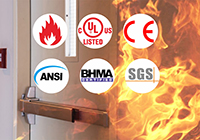
UL 10C certifies that a panic device can maintain its function during a fire event, but it does not test long-term mechanical wear the way ANSI/BHMA A156.3 does. This is why fire-rated panic hardware is typically specified with both certifications together: UL 10C confirms fire performance, while the ANSI/BHMA grade confirms how long the device will keep operating correctly under everyday mechanical stress.
A door that is both fire-rated and heavily trafficked — such as a stairwell escape route in a multi-story building — needs hardware that satisfies both requirements simultaneously. Specifying a Grade 2 device on a high-traffic fire door risks premature mechanical failure long before the door's fire rating would ever be tested by an actual fire.
The right grade depends on how often the door will be used and how critical continuous, trouble-free operation is to the building's safety plan.
Choose Grade 1 for escape routes, staircases, main entrances, and any door where hardware failure would create a safety or compliance risk. This is the standard specification for government, healthcare, education, and commercial projects with heavy daily traffic.
Choose Grade 2 for secondary or low-traffic doors where budget constraints are a bigger factor than maximum cycle life, and where door usage is infrequent enough that a lower cycle rating still provides a long service life.
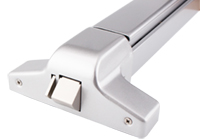
For most fire-rated exit applications, project specifiers and purchasing managers default to Grade 1 hardware because it removes the risk of hardware fatigue becoming a life-safety issue down the line. D&D Hardware manufactures its UL 10C panic exit devices — including the DDPD003, DDPD004, and DDPD005 series — to ANSI/BHMA A156.3 Grade 1, so the same device that passes fire testing is also built to survive the 500,000-cycle durability benchmark.
Is Grade 1 panic hardware more expensive than Grade 2?
Yes, Grade 1 hardware typically costs more upfront due to heavier-duty components and more rigorous testing, but it generally lowers total cost of ownership on high-traffic doors by reducing replacement and maintenance frequency.
Can Grade 2 panic hardware still be UL 10C fire-rated?
Yes. UL 10C certification and ANSI/BHMA grading are independent tests, so a Grade 2 device can carry a UL 10C fire rating. The grade only reflects mechanical durability, not fire performance.
Does ANSI/BHMA A156.3 apply to both rim and vertical rod exit devices?
Yes, the standard applies across panic hardware types, including rim exit devices and vertical rod exit devices, with the grade classification tested separately for each product category.
For further information about panic bars or any of our services, please click to Contact us Now:
Contact: David Jian
Mobile No.: 0086-139 2903 7292
Email: sales@danddhardware.com