Views: 0 Author: D and D Hardware Publish Time: 2026-06-26 Origin: D and D Hardware


Procuring UL fire rated commercial door hardware is one of the most consequential decisions in any commercial construction or renovation project. A wrong choice — whether due to mismatched certifications, incompatible components, or unreliable suppliers — can result in failed inspections, costly project delays, and serious liability exposure.
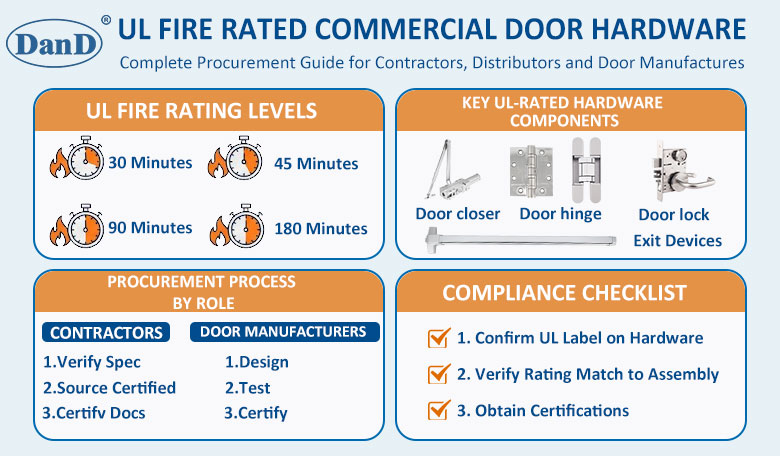
This guide is written from the perspective of a certified UL fire rated door hardware manufacturer with over 18 years of production experience supplying contractors, distributors, door manufacturers, and project buyers across global commercial markets. Our goal is to give B2B procurement professionals a practical, decision-focused resource — covering everything from product scope and certification verification to supplier evaluation, RFQ preparation, and order management.
Whether you are sourcing hardware for a single commercial project or establishing a long-term supply relationship, this guide will help you make informed procurement decisions with confidence.

UL fire rated door hardware refers to hardware components that have been independently tested and listed by Underwriters Laboratories (UL) for use in fire-rated door assemblies. This certification confirms that the hardware will perform as required during fire conditions — maintaining door closure, structural integrity, and egress functionality for a defined period.
From a procurement standpoint, the risk of using non-certified hardware goes well beyond product performance. In practice, non-compliant hardware can:
•Cause project inspection failures — AHJ (Authority Having Jurisdiction) inspectors routinely check hardware certifications during fire door inspections. Non-listed hardware is grounds for rejection.
•Invalidate the entire door assembly — A fire-rated door with non-listed hardware loses its fire rating classification, regardless of the door's own certification.
•Create legal and insurance liability — Building owners and contractors can face liability exposure if non-compliant hardware is found after an incident.
•Trigger costly rework — Replacing hardware after installation is significantly more expensive than sourcing correctly from the start.
For contractors, distributors, and door manufacturers, UL compliance is not optional — it is a project requirement that must be verified at the procurement stage.

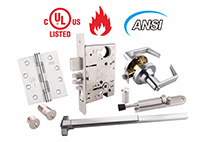
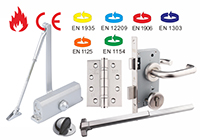
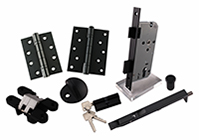
A complete fire door assembly requires multiple certified hardware components working together. Below is an overview of each product category from a procurement perspective — what it does, what to confirm before ordering, and what our certified offerings cover.
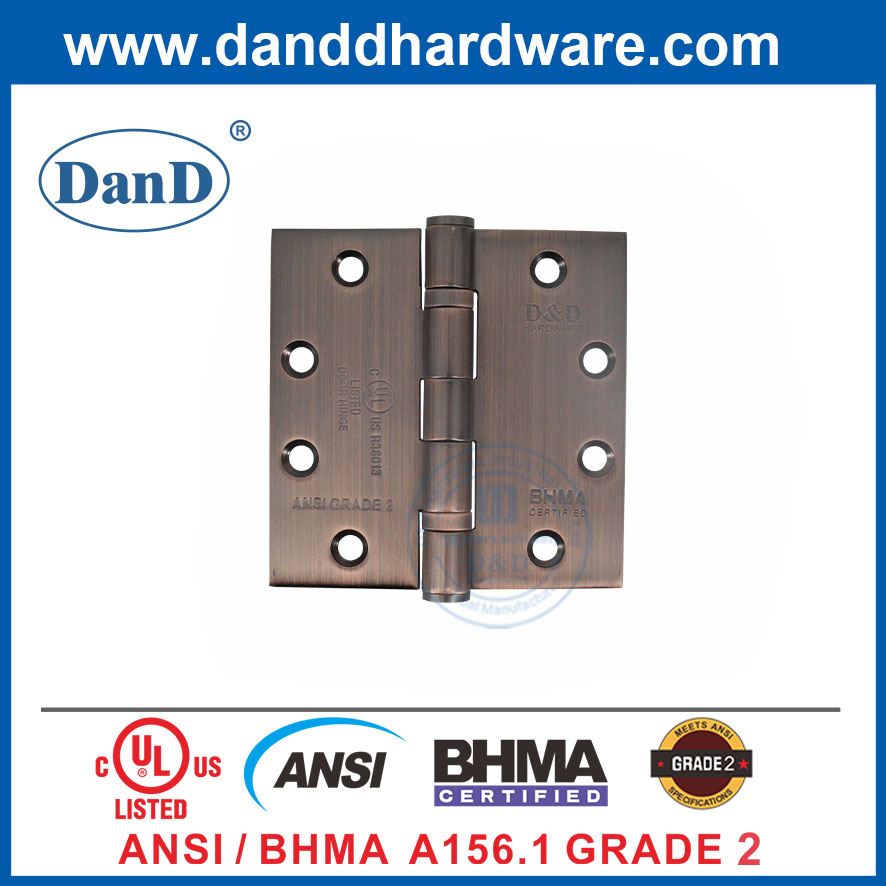
Function: Hinges bear the full weight of the door and must maintain structural integrity throughout a fire event. Failure of a hinge during a fire allows the door to collapse, defeating the entire fire compartmentalization system.
•UL 10C fire rating (positive pressure test) and fire rating duration (1.5 or 3 hours)
•ANSI/BHMA grade classification (Grade 1 for heavy commercial, Grade 2 for standard commercial)
•Door weight and size compatibility
•Finish and corrosion resistance requirements
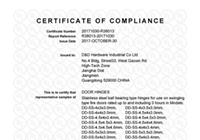
D&D certification: UL/cUL UL 10C Fire Rated — 3 Hours | File No. R38013 | ANSI/BHMA Grade 1 & Grade 2



Function: Concealed hinges (also called hidden hinges or European hinges) offer the same structural function as surface hinges while providing a clean architectural appearance. They are increasingly specified in premium commercial projects.
•UL 10C certification (not all concealed hinges carry fire ratings — verify explicitly)
•Load capacity relative to door weight
•Adjustability range (3-way adjustment is standard for commercial)
•Compatibility with door thickness and frame profile
D&D certification: UL 10C Fire Rated | File No. R38013


Function: Mortise locks provide the primary latching and locking function on fire-rated doors. They must maintain latch engagement under fire and hose stream conditions to keep the door closed during a fire event.
•UL 10C fire rating and test duration
•ANSI/BHMA function code (matching the door's security and egress requirements)
•Compatibility with the specified door prep (mortise pocket dimensions)
•Cylinder type and keying requirements
D&D certification: UL 10C Fire Rated — 3 Hours | File No. R40901


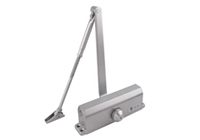
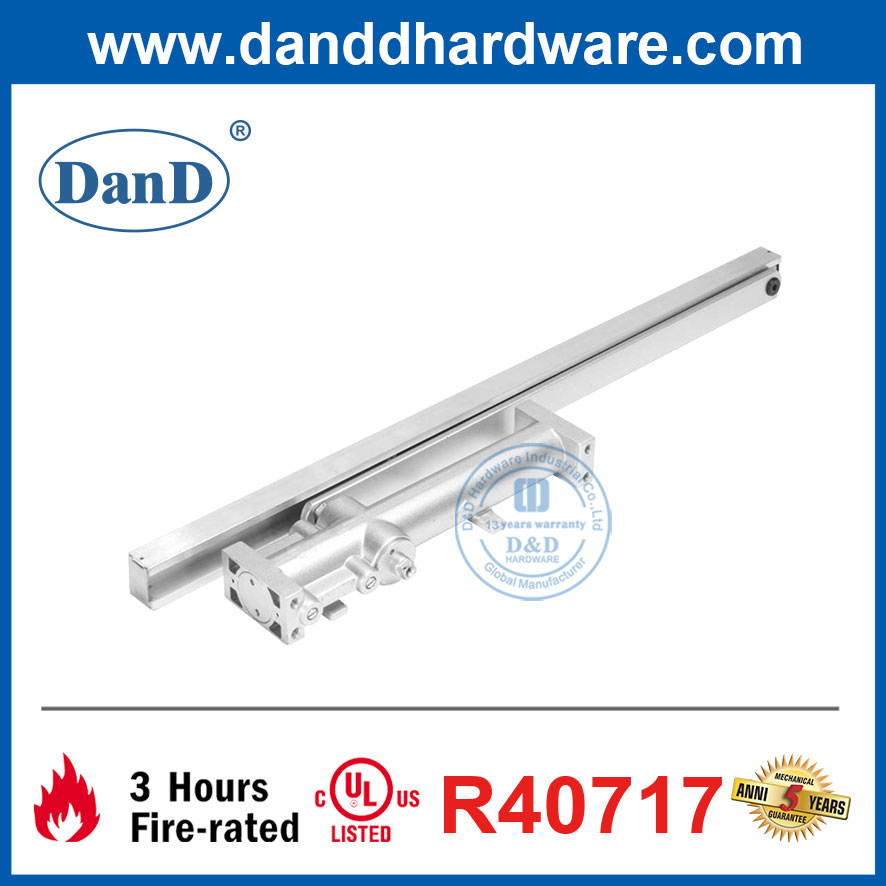
Function: Door closers ensure that fire doors automatically return to the fully closed and latched position after each use. This is one of the most critical functions in a fire door system — a door left open even briefly can allow fire and smoke to spread.
•UL 10C fire rating
•Door size and weight range (closers are sized; confirm the correct size/power rating)
•Mounting configuration (regular arm, parallel arm, top jamb)
•Adjustable closing and latching speed
•Backcheck and delayed action requirements (for accessibility compliance)
D&D certification: UL 10C Fire Rated — 3 Hours | File No. R40717


Function: Fire exit hardware (also called fire-rated panic hardware or crash bars) allows immediate egress from the building while maintaining fire door integrity. Required on fire doors serving high-occupancy spaces in most building codes.
•UL 10C fire rating (for fire-rated doors)
•ANSI/BHMA A156.3 Grade 1 compliance
•Door width and hand configuration
•Electric latch retraction or request-to-exit options (if access control integration is needed)
•Compatibility with door coordinator if used on pairs
D&D certification: UL 10C Fire Rated — 3 Hours | File No. R40486


Function: Panic hardware certified under UL 305 is tested specifically for life safety egress performance — ensuring reliable one-motion operation under emergency conditions. Used on doors where panic egress is required but a fire rating is not mandated.
•UL 305 listing (distinct from UL 10C — confirm which is required for your door assembly)
•Applicable building occupancy type
•Door hand and width
•Finish matching with other door hardware
D&D certification: UL 305 | File No. SA45817


Selecting the right manufacturer is as important as selecting the right product. Below are the key criteria procurement professionals should apply when evaluating potential suppliers.
A manufacturer's certification claims must be independently verifiable. Before proceeding with any supplier:
•Request the UL File Number for each product (not just a generic UL logo)
•Verify the file number directly on the UL Product iQ database (iq.ul.com)
•Confirm the scope of the listing — some UL files cover only specific product configurations
•Check the certification status — files can be suspended or withdrawn
•Request ANSI/BHMA test reports if grade compliance is specified in the project
A legitimate manufacturer will provide file numbers without hesitation. Vague responses or inability to provide verifiable documentation are significant red flags.
For commercial projects, sourcing all hardware components from a single manufacturer significantly reduces compatibility risk. When all products are designed and tested within the same manufacturing system, the risk of dimensional mismatches, finish inconsistencies, or conflicting performance characteristics is minimized.
Confirm whether the manufacturer can supply:
•The complete hardware package for your project (locks, closers, hinges, exit devices)
•Consistent finish options across all product categories
•Compatible product configurations for your specific door type and size
Large commercial projects require reliable production scheduling. Key questions to ask:
•What is the manufacturer's monthly production capacity for your required products?
•What is the standard lead time for bulk orders, and what are the lead times during peak periods?
•Does the manufacturer maintain safety stock for high-volume products?
•What is the process if a production delay occurs?
Request documented lead time commitments in your purchase agreement rather than relying on verbal assurances.
Many distributors and door manufacturers require OEM or private label supply arrangements. When evaluating this capability, confirm:
•Minimum order quantities (MOQ) for custom branding
•Packaging customization options
•Product labeling and documentation requirements
•Technical drawing and specification support
For international procurement, a manufacturer's export experience directly affects your ability to clear customs and meet project documentation requirements. Verify:
•Experience exporting to your target market (US, Canada, EU, etc.)
•Availability of required documentation (commercial invoice, packing list, certificate of origin, UL test reports)
•Ability to provide HS code classification support
•Experience with LC, T/T, and other payment terms as required
Request information on:
•In-process quality inspection procedures
•Final inspection standards before shipment
•ISO 9001 or equivalent QMS certification
•Policy for handling non-conforming products
A structured procurement process reduces risk at every stage. Below is the standard process we recommend and support for commercial fire door hardware projects.
Before issuing an RFQ, consolidate your project requirements:
•Fire rating required (1.5 hour or 3 hour)
•Door material and thickness
•Door width and weight
•Applicable building code (IBC, NFPA 80, local AHJ requirements)
•Finish requirements
•Quantity by product type
•Project timeline and delivery requirements
A well-structured RFQ reduces back-and-forth and ensures accurate quotations. Your RFQ should include:
•Product specifications (function, grade, finish, fire rating)
•Required certifications (UL file numbers if specified)
•Quantity per line item
•Delivery location and required delivery date
•Packaging requirements
•Required documentation (test reports, certification letters, etc.)
•Payment terms preference
For new supplier relationships or new product specifications, a sample approval stage is strongly recommended before bulk order placement:
•Request production samples (not showroom samples)
•Test for dimensional accuracy against your door prep specifications
•Verify finish and quality against your standards
•Confirm UL markings are present on the hardware
•Document approval in writing before proceeding to bulk order
Typical sample lead time: 7–15 business days depending on product complexity.
Before confirming a bulk order, ensure the following are documented in writing:
•Confirmed unit price and total order value
•Confirmed specifications (with reference to approved samples)
•Production lead time commitment
•Shipping terms (EXW, FOB, CIF, etc.)
•Payment terms and schedule
•Required shipping documents
Before shipment dispatch:
•Request pre-shipment inspection photos or video
•Confirm packing list matches PO quantities
•Obtain all required shipping documents
•Confirm UL certification documentation is included for the shipment

The market for fire door hardware includes products that carry fraudulent or misrepresented UL markings. This is particularly prevalent in lower-cost supply chains.
Mitigation: Always verify UL file numbers directly on ul.com/database before order placement. A valid UL listing will show the manufacturer name, product category, and listing scope.
Sourcing hardware components from multiple manufacturers without compatibility verification is a common cause of installation problems and inspection failures.
Mitigation: Source from a single manufacturer where possible, or request written confirmation that components from different sources are compatible within the intended fire door assembly.
Hardware that meets general UL requirements may not meet specific project specifications — for example, ANSI/BHMA grade requirements, specific function codes, or finish standards required by the architect or AHJ.
Mitigation: Provide detailed specifications in your RFQ and confirm compliance in writing before order placement.
Hardware delivery delays are among the most common causes of commercial project timeline disruptions.
Mitigation: Confirm production lead times in writing, build buffer time into your procurement schedule, and establish clear escalation procedures with your supplier for delay situations.
Some AHJ inspections and project closeout processes require hardware certification documentation that must be submitted by the contractor or door manufacturer. Failure to obtain this documentation at the procurement stage can create delays at project completion.
Mitigation: Request all certification documentation — UL test reports, product data sheets, installation instructions — at the time of order, not after delivery.
We are a specialized UL fire rated door hardware manufacturer with over 18 years of experience supplying commercial construction projects globally. Our certified product line covers the complete hardware package required for UL fire rated door assemblies.
Product | Certification | UL File No. | Rating |
Door Hinge | UL/cUL UL 10C | R38013 | 3 Hours |
Concealed Hinge | UL 10C | R38013 | Fire Rated |
Door Lock (Mortise) | UL 10C | R40901 | 3 Hours |
Door Closer | UL 10C | R40717 | 3 Hours |
Fire Exit Hardware | UL 10C | R40486 | 3 Hours |
Panic Hardware | UL 305 | SA45817 | — |
All UL file numbers are independently verifiable through the UL Product iQ database.
•Complete hardware packages — single-source supply for all fire door hardware components
•OEM and private label — custom branding, packaging, and documentation for distributors
•Project-specific support — hardware schedules, specification review, and technical consultation
•Export documentation — full compliance documentation for US, Canadian, and international projects
•Sample program — production samples available for specification approval
•Flexible order quantities — accommodating both project-specific orders and inventory stocking programs
Visit ul.com/database or productiq.ul.com and search using the UL file number provided by the manufacturer. The database will confirm the listing status, manufacturer name, and scope of certification. Always verify before placing an order.
UL 10C (Positive Pressure Fire Tests of Door Assemblies) certifies hardware for use in fire-rated door assemblies — it tests performance under fire and hose stream conditions. UL 305 (Panic Hardware) certifies the mechanical egress performance of panic hardware specifically. Some panic hardware applications require both; your project specifications and AHJ will determine which applies.
At minimum: UL test reports, product data sheets with UL file numbers, installation instructions, and a certificate of conformance. For import shipments, also request commercial invoice, packing list, and certificate of origin.
MOQ varies by product. Contact us with your product specifications and quantities for a specific quotation.
Yes. We offer OEM and private label supply for distributors and door manufacturers, including custom branding, packaging design, and technical documentation in your brand identity. Minimum quantities apply.
Standard samples are typically available within 7–15 business days from specification confirmation. Custom configurations may require additional time.
Standard lead times range from 30–60 days depending on product type and order volume. We will confirm production lead time at the quotation stage.
Yes. For project inquiries, we can assist with hardware schedule preparation and specification review to ensure all components meet your project requirements.