Views: 0 Author: D and D Hardware Publish Time: 2026-08-04 Origin: D and D Hardware


When a project calls for UL fire rated commercial door hardware, most buyers start by comparing product specs and price sheets. That's the easy part. The harder — and more consequential — question is who actually stands behind those products once the order is placed. A fire door hardware supplier evaluation that stops at "do they have the certificate" tends to surface problems later: inconsistent batches, missing documentation, or a supplier who simply can't keep up once the project scales.
This is why contractors, distributors, door manufacturers, and procurement teams increasingly treat supplier qualification as a formal step rather than a formality. Done properly, it protects the project from delays and rework, and it lays the groundwork for a supplier relationship that can outlast a single order.

What should buyers actually check before approving a fire door hardware supplier? At minimum: manufacturing experience, product certifications, quality control processes, technical support capability, production capacity, and a track record on comparable projects. For anything involving UL fire rated hardware specifically, prior production experience with fire-rated assemblies matters as much as the certificate itself — it's usually the difference between a supplier who understands the application and one who's simply selling a compliant part number.
Fire door assemblies only work as a system. A hinge, a mortise lock, a closer, an exit device, a panic bar — each one has to perform correctly on its own and in combination with the rest of the door. When a supplier's quality control is loose, the failure doesn't usually show up as a single bad part. It shows up as a door that doesn't close properly, documentation that doesn't match what shipped, or an install crew discovering a mismatch on site. By the time that happens, the schedule has already slipped and the cost of fixing it has already gone up.
None of this is hypothetical to anyone who has run a commercial door hardware procurement process more than once. It's exactly why experienced buyers build a qualification step into the process before the first purchase order, not after the first complaint.

How long has the company actually been building door hardware, and is commercial application their core business or a side line? A manufacturer that has spent years working with international buyers on commercial projects tends to understand procurement expectations — lead times, documentation, revision control — in a way that a smaller or more generalist shop often doesn't.
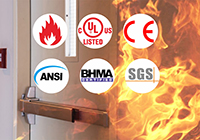
This is where the UL fire rated door hardware supplier question gets real. It's not enough to confirm a certificate exists somewhere in a folder. The more useful questions are whether the manufacturer can explain how their fire-rated line is controlled during production, whether they can supply the technical documentation a project engineer will actually ask for, and whether they understand how their hardware behaves within a full fire door assembly — not just as an isolated component.
Ask whether there's a documented process, not just a policy statement. Are incoming materials inspected? Is anything checked mid-production, or only at final QC? Are records kept in a way that could be produced if a project ever needed to trace a batch back to its source? Manufacturers operating under a structured system like ISO 9001 tend to have clearer answers to all of this, because the documentation habit is already built into how they run the floor.
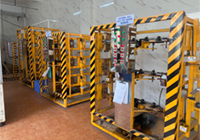
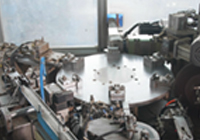
A supplier can look great on paper and still struggle once real volume hits. It's worth understanding what equipment they run, how experienced the workforce is, and what their realistic monthly output looks like — not the number in a sales deck, but the number they can actually hit consistently. This is a core part of any serious supplier qualification process, and it's usually the fastest way to separate a supplier who can handle a large commercial project from one who can't.
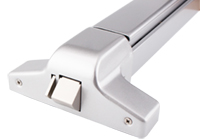
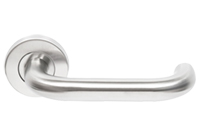
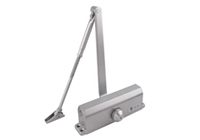
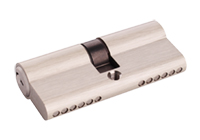
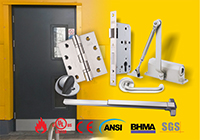
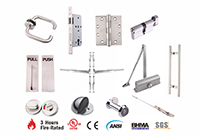
Projects rarely need just one category of hardware. A commercial door hardware supplier that can cover hinges, locks, closers, exit devices, panic hardware, handles, cylinders, and accessories under one roof simplifies life considerably — fewer vendors to manage, fewer compatibility questions between components from different factories, and one shipment instead of five. For distributors juggling multiple projects at once, this alone can be worth more than a marginally better price on any single item.
When a project reaches the specification or approval stage, someone is going to ask for a datasheet, an installation drawing, or a spec sheet that matches exactly what's being ordered. A supplier who can produce this quickly — and accurately — saves real time during approvals. This is one of the more underrated items on any door hardware sourcing checklist, mostly because it's invisible until you need it and then suddenly very visible.
Not every buyer needs this, but for distributors and hardware brands building their own product line, it's worth confirming upfront whether OEM commercial door hardware — custom finishes, private labeling, packaging, logo work — is something the manufacturer actually does routinely, or something they're agreeing to for the first time on your order.
Good hardware delivered late is still a schedule problem. Standard lead times, how orders are scheduled and tracked, export experience, and how a supplier handles an urgent request all matter more on construction timelines than they do on most other kinds of purchases, because a door hardware delay tends to hold up everything downstream of it.
This one is easy to underrate until it's missing. Clear quotations, fast responses, and a supplier who tells you about a problem before you have to ask about it — these are the things that make a multi-month project manageable instead of stressful.


Evaluation Area | What to Ask |
Manufacturing Experience | Do they specialize in commercial door hardware, or is it a side business? |
Fire Rated Capability | Can they support UL fire rated requirements with real production experience, not just paperwork? |
Quality Management | Is there a documented, followed process — not just a stated policy? |
Factory Capability | Can they hit the volume this project actually needs? |
Product Portfolio | Can they cover multiple hardware categories under one order? |
Technical Support | Can they produce drawings and documentation fast enough for approvals? |
OEM Capability | Do they have real experience with private label work? |
Delivery Performance | Do they have a track record of hitting project schedules? |
Communication | Are they responsive and upfront when something goes wrong? |

We built D&D Hardware around the idea that supplier qualification shouldn't be a leap of faith — it should be something a buyer can actually verify. With more than 18 years manufacturing commercial door hardware, we work with global buyers on UL fire rated hardware, run under an ISO 9001 quality system, and support both OEM and private label programs alongside full technical documentation. Our product range spans the categories most commercial and fire door projects need, backed by stable production and export capacity built for repeat business, not one-off orders.
The goal isn't to be the cheapest line item on a quote. It's to be the kind of fire rated hardware manufacturer a distributor or contractor can hand a project to and not have to double-check every shipment.
A supplier that can only sell you a product isn't the same as a supplier that can actually support your project. The real value shows up in fire door project procurement specifically, where quality lapses or delivery slips carry more weight than they would on a lower-stakes purchase — the downstream costs of a bad supplier choice (rework, delayed inspections, redone documentation) usually dwarf whatever was saved on unit price.


It's the process of confirming a manufacturer actually has the capability, quality systems, certifications, and track record a project needs — before, not after, the order is placed.
Because by the time a quality or delivery problem surfaces, it's already affecting the schedule. Qualification catches the risk earlier, when it's still cheap to fix.
No. It confirms the product is compliant, but it says nothing about whether the manufacturer can produce it consistently, document it properly, or deliver it on time — which is why commercial door hardware procurement teams look past the certificate itself.
Consistency, mostly. Good product capability matters, but so does manufacturing discipline, technical support that's actually responsive, and a delivery record that holds up under a real project timeline — not just a sample order.
Choosing a fire door hardware manufacturer is a decision that outlasts a single purchase order. A structured qualification process — one that looks past certifications into manufacturing capability, quality discipline, technical support, and delivery track record — gives procurement teams, contractors, and distributors a much better shot at a partnership that holds up across multiple projects, not just the current one.