Views: 0 Author: D and D Hardware Publish Time: 2026-11-09 Origin: D and D Hardware


A commercial door lock factory should be evaluated on its ability to reproduce an agreed product across a complete order. A polished sample demonstrates what a manufacturer can make once. Purchasing confidence comes from knowing how drawings, materials, assembly and inspection remain controlled when production scales.
For OEM buyers, importers and door manufacturers, the most useful evaluation follows one proposed lock from quotation to shipment. This reveals more than a general factory presentation and gives both parties a practical basis for purchasing.

Send a defined requirement before requesting a factory assessment: lock function, door thickness, backset, faceplate, strike, finish, quantities and required certification. Ask the factory to return a marked drawing and a quotation identifying included components.
Watch how discrepancies are handled. A manufacturer that flags an incompatible dimension before quoting is showing useful engineering judgment. An unexplained “yes” to every requirement leaves the buyer to discover conflicts later.
For OEM commercial door locks, agree which requirements are fixed and which can be developed. Custom appearance, door preparation and internal construction involve different production decisions.

During an onsite visit or live video review, ask to follow the proposed product through incoming inspection, component processing, assembly, testing and packing. Establish which operations are performed internally and which are subcontracted.
Outsourcing alone does not determine quality. The important questions concern responsibility: who approves incoming parts, checks externally applied finishes and prevents rejected components from returning to assembly?
Ask to see a redacted production traveler or equivalent record for a comparable lock. It should connect the model and drawing revision with the work being performed. Equipment photographs are less useful when nobody can explain which operations control your product’s fit and function.
Keep an approved reference sample, but support it with measurable requirements. “Same as sample” is difficult to enforce when an inspector must judge latch movement, fixing positions or finish variation.
Agree the dimensions and operating checks that matter to installation. Depending on the configuration, these may include latch projection, spindle alignment, strike engagement, lever return and key operation. Define inspection methods and acceptance criteria with the manufacturer before production.
Request samples selected from a pilot batch where practical. Comparing several assembled locks can expose variation that a specially prepared display sample conceals. A pilot order also tests labeling, accessory completeness and packing accuracy.
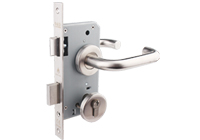
For a UL fire rated mortise lock, obtain the exact model identification and applicable certification record. Match the proposed configuration and product marking to that record; a file number should be a starting point for verification.
Ask how production changes affecting certified construction are reviewed. UL Solutions explains that its Follow-Up Services inspect manufacturing against certification requirements, including relevant materials and component traceability. Buyer inspection serves a different purpose and does not replace this certification oversight.
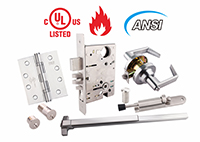
D&D Hardware offers applicable commercial door lock models with UL 10C Fire Rated 3 Hours coverage under File No. R40901. Confirm the selected model’s current scope and installation conditions for the intended opening. The lock’s certification does not independently establish the complete door assembly’s rating.

A useful audit question is: “What happens when this lock fails inspection?”
Ask for a redacted example showing how nonconforming products were identified, separated, investigated and rechecked. Look for a documented disposition rather than a verbal assurance that workers repair everything.
The same discipline should apply to OEM changes. Your purchase specification should require written approval before changes to agreed materials, components, drawings or finishes. Where certification is affected, the appropriate certification review must also occur.
This protects the buyer from receiving a substitute that looks acceptable but differs from the approved construction.

Before paying a deposit, agree what evidence supports shipment release. Specify the sampling plan, inspection timing, defect criteria, dimensional checks and documents required. Give the inspector the approved drawing revision and accessory list.
Confirm that packing lists distinguish functions, handing and finishes wherever relevant. A correctly manufactured lock packed with the wrong strike or fixing screws still creates a customer problem.
Delivery commitments should identify approval dependencies, including samples and artwork. Ask what happens when an inspection fails near the shipping date. A credible production plan includes time for corrective action and reinspection.
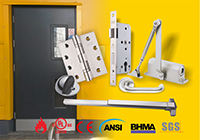
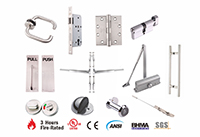
As a commercial door hardware manufacturer, D&D Hardware supports OEM discussions covering product configuration, finishes and packaging. ANSI-style locksets and lever handle locksets can also be supplied; their availability is separate from the UL certification statement above.
Send your drawings, quantities and inspection requirements to establish a reviewable production specification. This gives purchasing, engineering and the manufacturer a shared basis for sample approval and bulk supply.
Is a factory visit necessary before ordering commercial door locks?
It can help, but evaluate product-specific evidence as well. A live production review, documented inspections and a controlled pilot order can support an initial assessment.
What should an OEM buyer approve before production?
Approve drawings, function, materials, finish, accessories, markings and packaging. Identify the revision and document how changes require approval.
Does a UL file number cover every lock a factory supplies?
No. Verify the selected model and applicable configuration against the current certification record. Separate other product ranges from the certified offering.
What is the most useful first-order quality check?
Inspect pilot-batch products against agreed drawings and operating criteria, including accessory completeness. Use the findings to resolve production issues before increasing volume.