Views: 0 Author: D&D HARDWARE Publish Time: 2026-07-20 Origin: D&D HARDWARE


D&D Hardware tests every door hinge to ANSI/BHMA standards through a multi-stage quality control process — covering raw material inspection, dimensional verification, mechanical cycle testing, and fire-rating validation. This article explains exactly how that process works, and why it matters when sourcing certified commercial door hardware.
Specifying a BHMA door hinge for a commercial or fire-rated door project is only the first step. The harder question is: how do you know the hinge will actually perform to that standard once it leaves the factory? For architects, contractors, and procurement managers, the answer lies in the manufacturer's quality control system — not just their certification claims.
D&D Hardware Industrial Co., Ltd., an ISO 9001-certified ANSI door hardware supplier with over 18 years of manufacturing experience, applies a structured, multi-checkpoint testing protocol to every door hinge it produces. Here is a detailed look at what that process involves.
ANSI/BHMA standards are performance benchmarks established by the Builders Hardware Manufacturers Association (BHMA) and ratified by the American National Standards Institute (ANSI). For door hinges, the relevant standard is ANSI/BHMA A156.1, which defines requirements for:
Load-bearing capacity — the hinge must support the door's weight without deformation
Operational cycle life — typically 1,000,000 cycles for Grade 1, 500,000 for Grade 2
Finish durability — resistance to corrosion and surface wear
Material integrity — dimensional tolerances and material composition
BHMA Grade 1 is the highest classification, required for heavy-duty commercial and fire-rated door applications. BHMA Grade 2 is appropriate for standard commercial use. A hinge that carries ANSI/BHMA certification has been independently tested and verified against these criteria — not simply self-declared compliant.
D&D Hardware's quality control process follows a four-stage inspection model that begins before a single hinge is manufactured and continues through final shipment.
Every production run begins with material verification. D&D sources Grade 304 and Grade 316 stainless steel for its ANSI door hinge range, and each incoming batch is tested for:
Chemical composition — confirming correct steel grade and alloy ratios
Hardness and tensile strength — verifying the material will meet load-bearing requirements
Surface condition — checking for mill defects, pitting, or inconsistencies that would affect finish quality
Material that does not meet specification is rejected before it enters production. This upstream control prevents the most common source of field failures in door hardware: substandard base material that passes visual inspection but fails under load.
During manufacturing, D&D's inspection team performs dimensional checks at key production stages. For ANSI door hinges, this includes:
Leaf thickness and width — measured against ANSI/BHMA A156.1 dimensional tolerances
Knuckle alignment and barrel concentricity — ensuring smooth rotation and correct pin fit
Hole pattern accuracy — confirming screw hole placement matches standard door preparation dimensions
Weld and forming integrity — inspecting any formed or welded components for structural continuity
Dimensional non-conformances are flagged and removed from the production batch. This stage is particularly important for fire-rated hinges, where dimensional precision directly affects door alignment and self-closing performance under fire conditions.
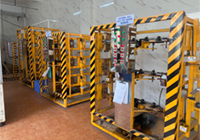
Completed BHMA door hinges are subjected to mechanical cycle testing using D&D's in-house inspection equipment. Cycle testing simulates real-world door operation to verify long-term durability.
Grade 1 hinges are tested to a minimum of 2,500,000 open-and-close cycles
Grade 2 hinges are tested to 1,500,000 cycles
Testing parameters include door weight loads representative of heavy commercial doors. After cycling, hinges are inspected for:
Pin wear and barrel deformation
Leaf fatigue or cracking
Finish degradation at stress points
Operational torque consistency
Hinges that show measurable degradation below the ANSI/BHMA performance threshold are disqualified from the certified product range.
For UL-listed and fire-rated ANSI door hinges, an additional validation stage is required. D&D works with third-party testing laboratories to confirm compliance with UL fire test protocols, which assess hinge performance under sustained high-temperature conditions consistent with a building fire scenario.
Finish durability is tested separately using salt spray (neutral salt fog) testing per ASTM B117, confirming that the hinge's surface treatment meets corrosion resistance requirements over the product's rated service life.

Choosing a certified BHMA door hinge — rather than an uncertified equivalent — affects more than product quality. It has direct implications for:
Building code compliance — many jurisdictions require ANSI/BHMA-rated hardware on commercial and fire-rated door assemblies
Insurance and liability — non-certified hardware in a fire-rated door assembly can void the assembly's fire rating and create liability exposure
Project specification alignment — architects and consultants frequently specify BHMA Grade 1 hardware; supplying a non-certified product risks project rejection
D&D Hardware is better suited for buyers who need full certification documentation, consistent batch quality, and technical support for complex projects. Uncertified low-cost alternatives may work for non-critical residential applications, but are not appropriate for commercial or fire-rated door specifications.
D&D produces a comprehensive range of ANSI-certified door hinges for commercial and fire-rated applications, including:
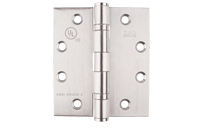
BHMA Grade 1 Full Mortise Hinges — for heavy-duty exterior and fire-rated doors (View product)
ANSI Grade 2 Full Mortise Hinges — for standard commercial door applications (View product)
UL-Listed Fire Door Hinges — tested and certified for use in UL fire-rated door assemblies (View product)
Ball Bearing Mortise Hinges — designed for high-traffic and heavy-door applications (View product)
All products are manufactured at D&D's SGS-audited factory in Jiangmen, Guangdong, China, and are backed by a 10-year mechanical guarantee.
Q: What is the difference between BHMA Grade 1 and Grade 2 door hinges?
BHMA Grade 1 hinges are tested to 1,000,000 operational cycles and are required for heavy-duty commercial, institutional, and fire-rated door applications. BHMA Grade 2 hinges are tested to 500,000 cycles and are appropriate for standard commercial doors with moderate traffic. Grade 1 is the correct choice for any door specified in a fire-rated assembly or high-use commercial environment.
Q: How can I verify that a door hinge supplier is genuinely ANSI/BHMA certified?
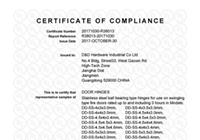
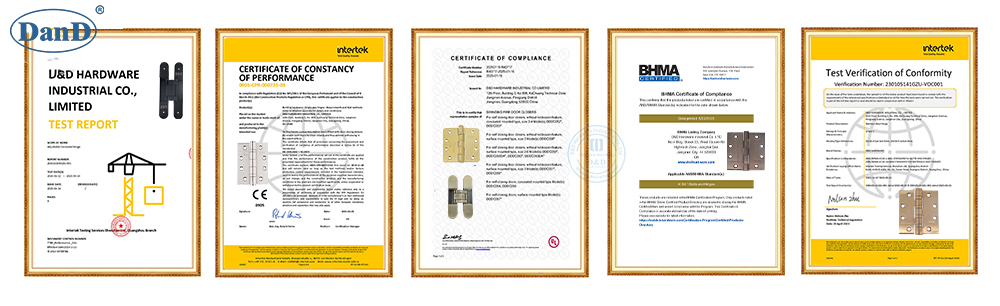
Legitimate ANSI/BHMA certification requires third-party testing by an accredited laboratory and ongoing product surveillance. Buyers should request the supplier's current BHMA certification certificate, confirm the specific product model listed on the certificate matches what is being supplied, and verify the certificate's validity period. D&D Hardware can provide full certification documentation upon request.
Q: Does an ANSI door hinge automatically qualify for use in a UL fire-rated door assembly?
Not necessarily. ANSI/BHMA certification and UL listing are separate qualifications. An ANSI-rated hinge confirms general performance and durability. A UL-listed hinge has additionally been tested for fire resistance as part of a rated door assembly. For fire-rated door applications, buyers should specify hinges that carry both ANSI/BHMA certification and UL fire listing. D&D Hardware supplies both.
Q: What documentation should an ANSI door hardware supplier provide for a commercial project?
A reliable ANSI door hardware supplier should be able to provide: current ANSI/BHMA certification certificates for each product, UL listing documentation where applicable, factory audit reports (such as SGS or ISO 9001 certification), test reports showing cycle life and finish durability results, and product-specific dimensional drawings. D&D Hardware maintains complete documentation packages for its certified product range.

D&D Hardware supplies ANSI/BHMA-certified door hinges to distributors, contractors, and door manufacturers across North America, Europe, and beyond. With over 18 years of manufacturing experience, an ISO 9001-certified production facility, and a full suite of ANSI, BHMA, UL, and CE-certified products, D&D delivers internationally branded quality at direct factory cost.
To request product specifications, certification documentation, or a project quote, contact D&D Hardware at sales@danddhardware.com or visit www.danddhardware.com.