Views: 0 Author: D and D Hardware Publish Time: 2026-10-17 Origin: D and D Hardware


School projects create a particular challenge for contractors: the hardware schedule may cover classrooms, corridors, stairwells, administrative areas, and service spaces, but these openings do not necessarily share the same lock requirements. Buying one model for every door can create avoidable specification problems. Ordering each opening separately, on the other hand, can make purchasing harder to control.

For contractors sourcing UL mortise locks for school projects, the practical task is to turn the approved door schedule into a clear purchasing package, then keep that package consistent through submittals, ordering, delivery, and installation. The aim is not simply to find a lock at the right price. It is to obtain the approved configuration, in the required quantity, at the right stage of construction.

A school may include classroom doors, corridor openings, stairwell doors, offices, storage rooms, and other spaces with different operational and compliance requirements. The door schedule and approved hardware set should determine which openings require fire-rated hardware and which lock functions are specified.
Before sending a request for quotation, group doors by the approved hardware set or lock model rather than relying only on room names. Two doors in different parts of a school may use the same approved configuration, while two nearby doors may require different functions.
A useful sourcing sheet records the door mark, approved lock function, model or performance requirements, quantity, finish, handing where applicable, and required delivery phase. This gives manufacturers a clearer basis for quoting and helps contractors identify missing information before it becomes a site issue.

Contractors should use the latest approved door schedule, hardware schedule, relevant drawings, and project specifications as the basis of the inquiry. If these documents disagree, the discrepancy should be resolved by the responsible design or project team before procurement proceeds.
The request for quotation should identify the required lock function, door preparation, material and thickness, finish, applicable fire-rating requirements, and any specified product or listing requirements. It should also state the quantity by model and the date each batch is needed.
This step is especially important when several buildings, wings, or construction phases are involved. A quote based on an early drawing revision may no longer match the approved specification. Including the revision date in the inquiry makes the basis of the quotation explicit.
The presence of a UL mark in a catalog is not enough to confirm that a lock is suitable for a particular school fire door. Buyers should verify the exact model, applicable listing scope, required rating, and compatibility with the approved door assembly and project requirements.
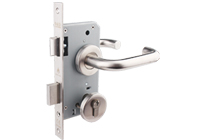
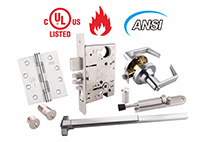
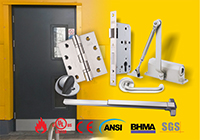
D&D Hardware’s UL fire-rated mortise lock series is associated with UL 10C and a three-hour fire rating under File No. R40901. Contractors should confirm the specific model and its applicable listing details before submitting it for approval or ordering it for a project.

Latch bolt operated by lever from either side except when outside lever is locked from outside by key. When outside lever is locked, latch bolt retracted by key, or by operating key and outside lever from outside or by operating inside lever. Auxiliary dead latch.
The lock’s individual certification should not be treated as proof that the complete door assembly complies. The project’s approved hardware schedule, door assembly listing, applicable code requirements, and authority having jurisdiction remain important to the final decision.

A complete submittal helps the reviewer compare the proposed lock with the project specification without having to request basic information repeatedly. Depending on the project, the package may include:
· Product datasheet with exact model identification
· Applicable UL listing information and file reference
· Dimensional drawing and installation requirements
· Lock function, finish, and configuration details
· Relevant compatibility information for the specified door assembly
· Sample or additional documents when required by the project team
Keep the model number consistent across the quotation, datasheet, drawing, sample label, and purchase order. If the manufacturer proposes an alternative, treat it as a formal substitution and obtain the required approval before placing the order.

School projects often have tight sequencing requirements. Hardware may be needed for one building or floor before the rest of the project is ready. A single delivery date for the full quantity may not match the installation plan.
Ask the manufacturer to confirm production lead time, available order quantities, packaging and labeling arrangements, and whether deliveries can be organized by building, floor, or approved hardware set. Agree on the schedule in writing and communicate changes early.
For phased projects, contractors should maintain a simple order tracker showing the approved model, quantity per phase, production status, planned shipment, and receiving status. This is more reliable than managing progress through scattered email threads.
A capable manufacturer should do more than issue a price. Contractors need a production partner that can understand the specification, identify missing information, provide accurate technical documents, and maintain the approved configuration through delivery.
When evaluating a manufacturer, ask how it controls model identification, production inspection, order changes, and repeat orders. Check whether the company can support the required project quantities and explain lead times clearly. If private-label packaging or project-specific labels are needed, confirm those requirements before production.
D&D Hardware is a commercial door hardware manufacturer with more than 18 years of manufacturing experience and an ISO 9001 quality management system. Its range includes UL fire-rated mortise locks and other commercial door hardware. For contractors, door manufacturers, and distributors, direct coordination with D&D can support model clarification, technical documentation, OEM requirements, and production planning.

Changes can occur when a door schedule is revised, an opening’s function changes, or a specified model becomes unavailable. A similar-looking lock should not be substituted automatically, particularly where fire-door requirements apply.
Record the original approved model, the reason for the proposed change, and the details of the alternative. Obtain the necessary technical and project approvals, then update the purchase order and installation records. Make sure the receiving and installation teams know which revision applies to each delivery.
This discipline reduces the chance of mixing approved and unapproved products across buildings or phases and makes later maintenance easier.
· The latest door and hardware schedules have been confirmed.
· Doors are grouped by approved hardware set or lock model.
· Lock functions, quantities, finishes, and door preparation are clear.
· The exact model and applicable UL listing details have been reviewed.
· Required submittals and approvals are complete before release.
· Production lead time and phased delivery dates are agreed.
· Substitution and specification-change procedures are documented.
· Model identification and order records are retained for future replacement.

For school projects, reliable sourcing begins with an accurate door schedule and a complete inquiry—not with a broad request for a low-cost lock. Contractors should confirm the approved model, verify applicable listing details, submit consistent documentation, and coordinate deliveries with the construction sequence.
Working directly with a commercial door hardware manufacturer can make technical clarification and production planning more straightforward. D&D Hardware supports B2B customers with commercial door hardware manufacturing, UL fire-rated mortise lock products, technical documentation, and OEM supply capabilities. Providing the approved hardware schedule, quantities, and required delivery phases at the quotation stage gives the manufacturer a clearer basis for responding to the project.
Can One UL Mortise Lock Model Be Used for Every Door in a School?
Not necessarily. Lock functions and fire-door requirements depend on the approved door schedule and intended application. Contractors should confirm each opening or approved hardware group before ordering.
What Should Contractors Send When Requesting a Quote?
Send the current door and hardware schedules, required lock functions, model or performance requirements, quantities, finishes, relevant drawings, and delivery phases.
Does a UL-Listed Mortise Lock Automatically Make a School Fire Door Compliant?
No. Buyers must confirm the exact model and listing scope, as well as its suitability for the approved door assembly and applicable project requirements.
Why Source Directly from a Door Hardware Manufacturer?
Direct communication can help contractors clarify specifications, coordinate documentation, plan production, and manage repeat orders. The manufacturer’s actual capabilities and product documentation should still be checked against the project requirements.