Views: 0 Author: Site Editor Publish Time: 2026-02-26 Origin: Site


Double doors are everywhere—office buildings, hospitals, schools, and hotels. They offer wide passage and a sense of grandeur. But there's a hidden component working behind the scenes to keep these doors functioning safely and effectively: the door coordinator.
If you've ever wondered why double doors close in a specific sequence or how they maintain fire safety ratings, the answer lies in this small but essential piece of hardware.
A door coordinator, also known as a door selector, is a mechanical device that controls the closing sequence of double doors. Its job is to ensure that when both door leaves swing shut, the inactive leaf (the one that typically remains stationary) closes first, followed by the active leaf (the one people usually push or pull).
Why does this matter? When both leaves are equipped with latching hardware, the active leaf's latch bolt must project into the inactive leaf or door frame to secure the opening properly. If the active leaf closes first, its extended latch bolt blocks the inactive leaf from closing. This leaves a dangerous gap—one that compromises security, energy efficiency, and, most critically, fire safety.
The door coordinator prevents this problem by physically holding the active leaf open until the inactive leaf has closed and cleared the path. Only then does the active leaf swing shut and latch securely.
Door coordinators are required in specific situations, particularly where life safety and building codes intersect. You'll typically find them on:
Fire-rated double doors: These doors must close and latch fully to contain smoke and flames during an emergency. A coordinator ensures both leaves close in the correct order to maintain the fire rating.
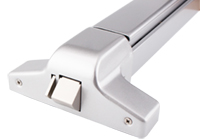
Doors with vertical rod exit devices: The inactive leaf often has vertical rod panic hardware or automatic flush bolts. These require the inactive leaf to close first to engage properly.
Doors with overlapping astragals: An astragal is a vertical strip attached to one door leaf that overlaps the other when closed. Coordinators ensure proper sequencing so the astragal seals the gap between leaves.
In commercial buildings—especially those subject to fire codes like the International Building Code (IBC) or NFPA 80—door coordinators aren't just recommended. They're mandatory.
The mechanics vary depending on the type of coordinator, but the principle remains the same: the active leaf is held in place until the inactive leaf passes a trigger point during closing.
Soffit-Mounted Coordinators
Soffit-mounted coordinators attach to the underside (soffit) of the door frame head. A bolt extends from the coordinator body, holding the active leaf open. As the inactive leaf swings closed, it compresses a trigger mechanism, releasing the bolt and allowing the active leaf to follow.
These coordinators are popular because they're discreet and can be painted to match the frame. Auxiliary brackets can be added to support closer brackets or mounting hardware for other devices.
Gravity Coordinators
Gravity coordinators use a pivoting arm mounted on the face of the door frame head. When the inactive leaf opens, the arm drops down, physically blocking the active leaf from closing. As the inactive leaf swings shut, it pushes the arm back up, releasing the active leaf.
While effective, gravity coordinators are more visible and prone to tampering or damage. They're often used in industrial or back-of-house areas where aesthetics are less of a concern.
Spring-Loaded Coordinators
Spring-loaded coordinators rely on a spring-loaded arm that releases when the doors open. This arm holds the active leaf until the inactive leaf's closing motion triggers its release.
These are commonly used in wood door applications and can be installed on the frame or door edge depending on the model.
When a fire breaks out, every second counts. Fire-rated doors are designed to compartmentalize a building, slowing the spread of smoke and flames to give occupants time to evacuate. But a fire door is only as effective as its ability to close and latch properly.
According to NFPA 80 (Standard for Fire Doors and Other Opening Protectives), fire-rated double doors must close in sequence to maintain their fire rating. If the active leaf closes first and blocks the inactive leaf, the opening remains partially ajar. Smoke, heat, and flames can pass through, defeating the door's purpose.
Building inspectors and fire marshals routinely check for properly functioning door coordinators during safety audits. Failure to install or maintain them can result in code violations, fines, or worse—liability in the event of a fire.

Not all coordinators are created equal. The Builders Hardware Manufacturers Association (BHMA) has established standards under ANSI/BHMA A156.3 to classify coordinators based on performance and application. Understanding the differences helps you choose the right hardware for your project.
Type 1: Soffit-Mounted
Best for applications where aesthetics and durability matter. These are typically available in primed steel or select finishes and can integrate with other door hardware like closers and exit devices.
Type 2: Gravity
Ideal for heavy-duty or industrial settings. Gravity coordinators are robust and simple, but their exposed arm makes them vulnerable to vandalism.
Type 3: Spring-Loaded
Often used on wood doors or lighter commercial applications. They're less common than soffit-mounted or gravity types but offer a reliable alternative in certain situations.
Installing a door coordinator requires precision. Improper installation can lead to doors that won't close properly, excessive wear on hardware, or failure to meet fire safety codes.
Key installation steps include:
Positioning: The coordinator must be mounted in the correct location on the frame head or soffit, aligned with both door leaves.
Adjustment: Some coordinators have adjustable arms or triggers to fine-tune the timing of the release mechanism.
Testing: After installation, both leaves should be opened and released multiple times to verify proper sequencing.
Coordination with other hardware: Door closers, exit devices, and strikes must all work in harmony with the coordinator. Conflicts between devices can prevent proper operation.
For fire-rated doors, installation must comply with the manufacturer's instructions and applicable fire codes. Any deviation can void the door's fire rating.
Even the best door coordinators can experience problems over time. Here are some common issues and their causes:
Active leaf closes first: This usually indicates the coordinator is misaligned, damaged, or not installed correctly.
Inactive leaf doesn't close fully: The door closer may need adjustment, or there may be friction in the hinges or frame.
Coordinator arm sticks or jams: Dirt, paint buildup, or lack of lubrication can cause mechanical failure. Regular maintenance prevents this.
Excessive noise: Squeaking or grinding sounds often mean the coordinator needs lubrication or a worn component needs replacement.
Routine inspections and maintenance are essential, especially for fire-rated openings. Building managers should include door coordinators in their preventive maintenance schedules.
Selecting the appropriate coordinator depends on several factors:
Door material: Steel, wood, or aluminum doors may require different mounting hardware.
Fire rating: Fire-rated openings require coordinators tested and listed for fire door assemblies.
Traffic level: High-traffic openings need heavy-duty coordinators built to withstand frequent use.
Aesthetics: Soffit-mounted coordinators are less obtrusive and easier to conceal than gravity types.
Budget: While cost is a consideration, skimping on quality can lead to premature failure and costly repairs.
Working with a reputable hardware supplier ensures you get a coordinator that meets code requirements and performs reliably for years.
While fire safety is the primary driver for door coordinators, proper sequencing offers additional benefits:
Energy efficiency: Fully closed and latched doors prevent air leakage, reducing heating and cooling costs.
Security: Doors that latch properly are harder to force open, enhancing building security.
Noise control: Properly sealed doors minimize sound transfer between rooms.
Longevity: Coordinators reduce stress on latches, strikes, and door frames by ensuring smooth, controlled closing.
1
Double doors are more complex than they appear. Behind their smooth operation lies a network of hardware working in concert—hinges, closers, exit devices, and coordinators. Each component plays a role, but the door coordinator often goes unnoticed until something goes wrong.
Whether you're specifying hardware for a new construction project, retrofitting an existing building, or troubleshooting a problem opening, understanding door coordinators is essential. They're not just a code requirement—they're a critical safety device that protects lives and property.
Choose quality hardware, follow proper installation procedures, and maintain your coordinators regularly. When it matters most, you'll be glad you did.