Views: 0 Author: D&D HARDWARE Publish Time: 2026-03-25 Origin: D&D HARDWARE


UL 10C Certified · 18+ Years Manufacturing
From hospitals and schools to hotels and government facilities — when fire safety and security cannot be compromised, D&D Hardware's UL-certified mortise locks deliver proven, code-compliant performance for every commercial application.

 Table of Contents
1. What Is a UL-Listed Mortise Lock?
2. Understanding UL 10C Fire Rating
3. UL Listed vs. Non-UL Mortise Locks: Key Differences
4. ANSI Grade 1 + UL Listed: The Dual Standard for Commercial Buildings
5. Why UL-Listed Mortise Locks Are Essential for Fire Doors
6. Building Code Requirements: IBC, NFPA 80, and Beyond
7. Application Guide: Steel Doors, Wooden Doors & Commercial Entries
8. How to Choose the Right UL Mortise Lock for Your Project
9. D&D Hardware's UL Mortise Lock Product Range
10. Why Specify D&D Hardware?
11. Frequently Asked Questions (FAQ)
Modern commercial buildings face increasingly stringent safety regulations. Architects, contractors, building managers, and distributors worldwide are under pressure to specify hardware that not only secures a building but also ensures life safety during a fire emergency. Among all door hardware components, the mortise lock plays a uniquely critical role — and when it carries a UL listing, it becomes a cornerstone of a certified fire door assembly.
This guide covers everything you need to know about UL-listed mortise locks for commercial doors: what the certification means, why it matters, where it is required, and how D&D Hardware's industry-leading product range can meet your project's most demanding specifications.

Underwriters Laboratories (UL) is a globally recognized, independent safety certification organization with over a century of testing history. A UL-listed mortise lock is a locking mechanism that has been submitted to UL for testing and has successfully met all applicable performance requirements. The UL listing is not self-declared — it is earned through rigorous, third-party laboratory testing.
Unlike surface-mounted rim locks or simple cylindrical locks, a mortise lock is installed within a deep pocket (the "mortise") cut into the door edge. This embedded installation provides superior structural strength, tamper resistance, and the ability to integrate multiple locking functions — latchbolt, deadbolt, and auxiliary deadlatch — within a single, compact lock body.
Key Insight for Specifiers: A UL listing on a mortise lock confirms that the product has been independently tested for fire resistance, operational reliability under extreme heat, and structural performance as part of a complete fire door assembly. It is not merely a quality mark — it is a safety certification.
When a mortise lock carries the UL mark, it verifies the following critical performance factors:
* Fire resistance during sustained high-temperature exposure
* Mechanical operability after fire testing (ensuring egress is maintained)
* Structural integrity of the lock body, bolts, and strike under fire conditions
* Compatibility with the fire-rated door assembly as a whole
The UL 10C standard — formally titled "Standard for Positive Pressure Fire Tests of Door Assemblies" — is the most widely referenced fire test for door hardware in North America and many international markets. It is more demanding than earlier fire tests because it simulates the positive pressure differential that occurs during a real building fire, where hot gases actively push against the door.
A mortise lock undergoing UL 10C certification is subjected to a full battery of tests as part of a complete door assembly:
* Fire Endurance Test: The door assembly is exposed to a controlled fire for the full rated duration (e.g., 3 hours), during which the lock must maintain structural integrity.
* Positive Pressure Test: The fire side of the door is maintained at a higher pressure than the non-fire side, simulating real fire dynamics and preventing smoke bypass.
* Operational Testing: After fire exposure, the lock mechanism must still be operable, ensuring occupants can evacuate safely.
* Hose Stream Test: A high-pressure water stream is applied to the assembly immediately after the fire test to evaluate resistance to sudden thermal shock.
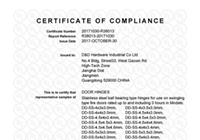
D&D Hardware UL Certification: All D&D Hardware UL mortise locks are certified under UL 10C with a 3-hour fire rating, documented under UL File No. R40901. This is the highest fire rating available for commercial door hardware and is accepted for the most demanding applications, including stairwell enclosures, fire barrier walls, and hazardous occupancy doors.
| Fire Rating | Typical Application | Code Reference |
| 90 Minutes | Corridor doors, office partitions, exit access doors | IBC Table 716.1(2) |
| 2 Hours (120 Min) | Stairwell enclosures, exit passageways | IBC Section 1023.4 |
| 3 Hours (180 Min) | Fire barriers, occupancy separations, high-hazard areas | IBC Section 707, NFPA 80 |
The decision to specify a UL-listed mortise lock versus a non-certified alternative is not merely a matter of preference — it carries significant legal, safety, and financial implications. The following comparison illustrates why certified hardware is the only responsible choice for commercial fire door applications.
| Feature | D&D Hardware UL-Listed Mortise Lock | Non-UL Mortise Lock |
| Fire Testing | ✔ Independently certified to UL 10C (3-hour) | ✘ No independent fire verification |
| Building Code Acceptance | ✔ Accepted under IBC, NFPA 80, and local codes | ✘ Typically not permitted on fire-rated openings |
| Material Standard | ✔ SUS304 stainless steel — corrosion-resistant, high-strength | ✘ Material quality varies; often inferior alloys |
| Mechanical Durability | ✔ ANSI Grade 1 — 1,000,000+ cycle tested | ✘ Unverified cycle life |
| Liability & Insurance | ✔ Documented certification reduces liability risk | ✘ Potential liability in the event of fire-related failure |
| Audit & Inspection | ✔ Passes AHJ (Authority Having Jurisdiction) inspections | ✘ May fail inspection, requiring costly replacement |
| Long-Term Value | ✔ Durable, low-maintenance, long service life | ✘ Higher total cost of ownership due to premature failure |
Two separate but complementary standards govern the performance of commercial mortise locks. Understanding both is essential for proper specification.
The American National Standards Institute (ANSI) and the Builders Hardware Manufacturers Association (BHMA) jointly administer the A156.13 standard for mortise locks. Grade 1 is the highest performance tier, requiring:
*Minimum 1,000,000 operation cycles without failure
*Deadbolt throw of at least 1 inch (25.4 mm)
*Resistance to forced entry and torque attacks
*Corrosion resistance of all external components
While ANSI Grade 1 addresses mechanical durability, UL certification addresses fire safety. A lock can be Grade 1 without being UL-listed, and vice versa. For commercial fire door applications, both certifications are required.
D&D Hardware Advantage: Every D&D Hardware UL mortise lock is certified to both ANSI/BHMA A156.13-2005 Grade 1 and UL 10C. This dual certification means you receive a lock that is mechanically proven for 1 million+ cycles of heavy commercial use AND fire-tested to protect occupants for up to 3 hours. This is the complete package for commercial specification.

A fire-rated door is only as strong as its weakest component. Building codes and fire safety standards are explicit: every element of a fire door assembly — including the lock — must be certified to maintain the assembly's fire rating. Installing a non-UL-listed lock on a fire-rated door effectively voids the door's fire rating, creating a dangerous gap in the building's passive fire protection system.
A properly specified UL-listed mortise lock for fire doors provides the following critical benefits:
*Maintains fire door assembly integrity: The lock will not fail, warp, or seize during a fire, ensuring the door remains closed and functional as a fire barrier.
*Ensures safe emergency egress: Even after prolonged fire exposure, the lock mechanism remains operable, allowing occupants to exit safely.
*Prevents smoke migration: The positive pressure test confirms the lock and door assembly prevent smoke — the leading cause of fire fatalities — from spreading to adjacent areas.
*Protects building owners from liability: Using certified hardware demonstrates due diligence and compliance with applicable codes.
In most commercial jurisdictions globally, the use of UL-listed hardware on fire-rated door assemblies is not optional — it is mandated by law. The primary standards that govern this requirement include:
*International Building Code (IBC): Sections 716 and 715 require that hardware on fire door assemblies be listed and labeled by an approved testing agency.
*NFPA 80 — Standard for Fire Doors and Other Opening Protectives: Section 4.1.4 requires that all hardware on fire door assemblies be listed for use with the specific door and frame assembly.
*NFPA 101 — Life Safety Code: Governs egress requirements, including the operability of locking mechanisms on fire-rated egress doors.
*Local and Regional Codes: Many jurisdictions in the USA, Middle East, and Southeast Asia adopt IBC and NFPA standards directly or with modifications, all of which require UL-listed hardware.
For Healthcare, Education & Government Projects: Facilities regulated by The Joint Commission (TJC), state health departments, or federal agencies often have additional requirements beyond the base building codes. D&D Hardware's UL-listed mortise locks meet or exceed all these requirements, making them the specification of choice for the most demanding institutional projects.
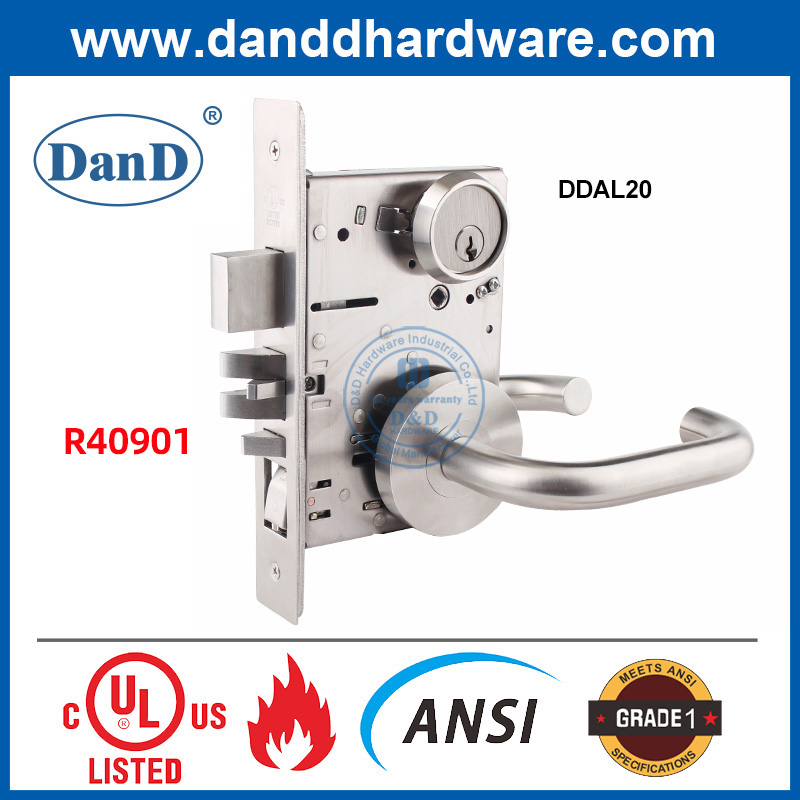
Steel is the dominant material for commercial fire doors in North America, the Middle East, and institutional construction globally. A UL-listed mortise lock for hollow metal doors must account for the unique thermal behavior of steel: it conducts heat rapidly and expands significantly under fire conditions. D&D Hardware's DDAL series locks are engineered and tested specifically for steel door applications, ensuring the latchbolt and deadbolt remain fully operable even after the door frame has experienced significant thermal distortion.
Wood behaves differently from steel under fire — it chars and swells rather than conducting heat. A UL-listed mortise lock for wooden fire doors must be compatible with fire-resistant wood core and composite door assemblies. D&D Hardware's locks are tested and listed for use in both steel and wood door assemblies, providing flexibility for projects that incorporate both door types.
For lobbies, main entrances, stairwells, and high-traffic corridors, the lock must balance security with ease of use and long-term durability. D&D Hardware's ANSI Grade 1 locks are rated for 1,000,000+ cycles, making them ideal for environments where the door may be used hundreds of times per day. Multiple finish options — including Satin Stainless Steel (SSS), Polished Stainless Steel (PSS), Matte Black (MB), and PVD finishes — allow seamless integration with any architectural design intent.
| Building Type | Recommended Function | Key Requirement |
| Hospital / Healthcare | DDAL04 (Entrance), DDAL22 (Privacy) | UL 10C, ADA compliance, easy egress |
| School / University | DDAL05 (Classroom), DDAL07 (Storeroom) | Lockdown capability, ANSI Grade 1 |
| Hotel / Hospitality | DDAL09 (Apartment Entry), DDAL20 (High Security) | Aesthetic finishes, durability, fire rating |
| Office Building | DDAL04 (Entrance), DDAL05 (Classroom/Office) | Access control compatibility, Grade 1 |
| Government / Data Center | DDAL20 (High Security), DDAL07 (Storeroom) | Maximum security, UL listing, tamper resistance |
| Residential / Apartment | DDAL09 (Apartment), DDAL13 (Dormitory) | Ease of use, fire rating, anti-pick latch |

Selecting the correct UL-listed mortise lock requires a systematic evaluation of several project-specific factors. The following framework will guide your specification process:
1. Determine the Required Fire Rating: Consult the project's fire door schedule and applicable building codes to establish whether 90-minute, 2-hour, or 3-hour rated hardware is required. D&D Hardware's full DDAL range is certified to the maximum 3-hour UL 10C rating, providing flexibility for any requirement.
2. Identify the Door Material: Specify whether the lock will be installed in a hollow metal (steel) or wooden fire door. D&D Hardware's locks are tested and listed for both applications.
3. Select the Appropriate ANSI Function: The ANSI function determines how the lock operates — who can lock and unlock it, and from which side. Refer to the product function table below for guidance.
4. Confirm Backset and Door Thickness: D&D Hardware's standard backset is 2-3/4" (70mm) with a door thickness range of 45mm to 55mm. Custom backsets and door thickness accommodations are available through our OEM/ODM service.
5. Choose the Finish: Select a finish that complements the architectural design intent. Options include SSS (Satin Stainless Steel), PSS (Polished Stainless Steel), MB (Matte Black), AB (Antique Brass), AC (Antique Copper), and PVD coatings.
6. Verify Code Compliance: Confirm that the specified lock is listed under the UL file number required by the Authority Having Jurisdiction (AHJ). D&D Hardware's UL File No. is R40901.
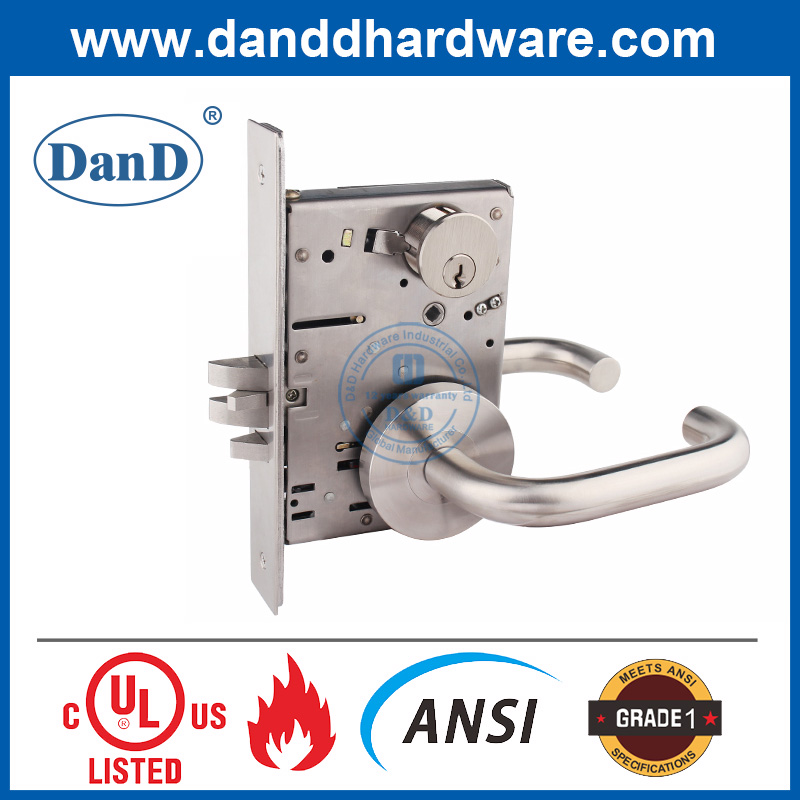
D&D Hardware offers a comprehensive range of UL-listed mortise locks under the DDAL series, all certified to ANSI/BHMA A156.13-2005 Grade 1 and UL 10C 3-hour fire rating (File No. R40901). The complete technical specifications are as follows:
| Specification | D&D Hardware DDAL Series |
| Certification | ANSI/BHMA A156.13-2005 Grade 1; UL 10C Fire Rated 3 Hours; UL File No. R40901 |
| Lock Case | Heavy Gauge Stainless Steel — corrosion-resistant, high-strength |
| Deadbolt | Solid Casting SUS304, 1" (25.4mm) throw |
| Latchbolt | Solid Casting SUS304, 3/4" (19mm) throw, anti-friction two-piece design, reversible |
| Auxiliary Latchbolt | Stainless Steel — deadlocking function for anti-manipulation security |
| Forend & Strike | Stainless Steel Grade 304, non-handed strike |
| Door Thickness | 45mm to 55mm standard; custom available |
| Backset | 2-3/4" (70mm) |
| Center to Center | 3-5/8" (92mm) |
| Door Handing | Left Hand and Right Hand (field reversible) |
| Available Finishes | SSS, PSS, MB (Matte Black), AB (Antique Brass), AC (Antique Copper), PVD Gold |
| Usage | Hollow Metal (Steel) Doors and Wooden Doors |
The DDAL series covers the full spectrum of commercial locking functions required by architects and specifiers:

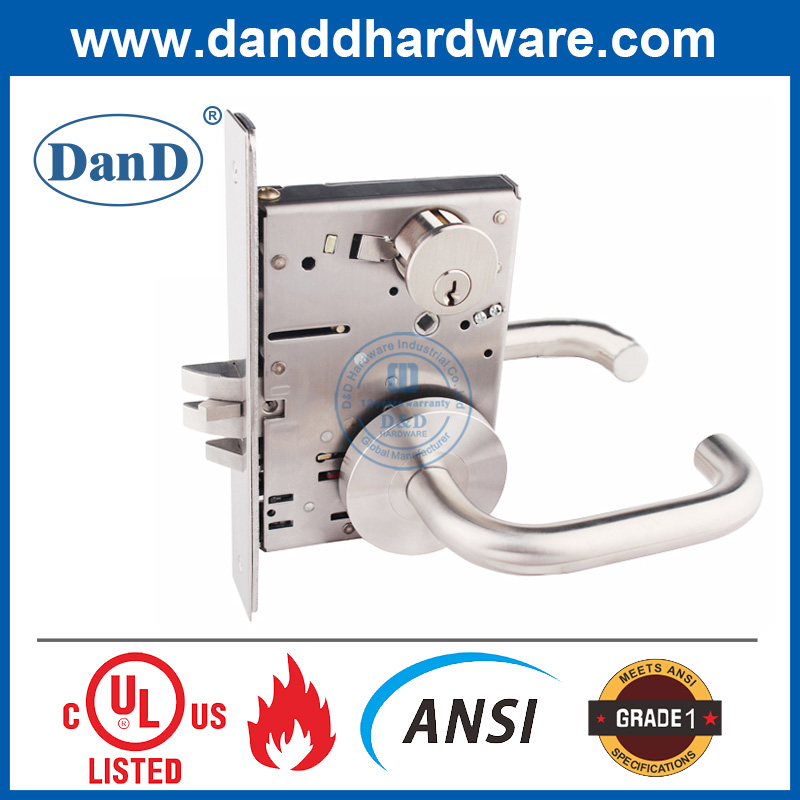


Latchbolt by lever both sides; deadbolt by key outside or thumbturn inside. For dormitories and exit doors.
 DDAL19
Privacy Lock
Latch bolt by lever either side; dead bolt by turn inside or emergency outside. Inside lever retracts both. For bedroom and bathroom.

18 years of manufacturing excellence, trusted by architects, contractors, and distributors across 60+ countries.

All locks carry an active UL listing under File No. R40901. Fully verifiable on the UL Product iQ database. No grey-market certificates.

Lock case, deadbolt, latchbolt, forend, and strike are all manufactured from Grade 304 stainless steel for maximum corrosion resistance and structural strength.

We understand the specific code requirements and market expectations of the USA, Europe, Middle East, and Southeast Asia. Our products are specified on projects worldwide.

From passage latches to high-security entrance locks, our DDAL series covers every commercial function required by architects and specifiers.


The following questions represent the most common queries from architects, contractors, distributors, and building managers when specifying UL-listed mortise locks for commercial projects.
A UL-listed mortise lock has been independently tested and certified by Underwriters Laboratories to meet specific fire resistance and performance standards. A standard mortise lock may be mechanically similar but has not undergone this third-party fire testing. On fire-rated door assemblies, only UL-listed hardware is accepted by building codes and Authorities Having Jurisdiction (AHJ).
UL 10C ("Positive Pressure Fire Tests of Door Assemblies") tests door assemblies under conditions where the fire side is maintained at a higher pressure than the non-fire side, simulating real fire dynamics. UL 10B uses neutral pressure conditions. UL 10C is more stringent and is required by NFPA 80 and most current building codes for commercial fire door assemblies.
Yes. The International Building Code (IBC) and NFPA 80 both require that hardware on fire-rated door assemblies be listed and labeled by an approved testing organization such as UL. This requirement applies to virtually all commercial, institutional, and multi-family residential construction in the USA and many international markets that adopt these codes.
For commercial applications, ANSI Grade 1 is the required standard. Grade 1 locks are tested to 1,000,000+ operation cycles and provide the highest level of mechanical durability and security. D&D Hardware's entire UL mortise lock range is certified to ANSI/BHMA A156.13 Grade 1.
Yes. D&D Hardware's DDAL series locks are tested and listed for use on both hollow metal (steel) and wooden fire door assemblies. Please specify the door type when requesting a quote to ensure the correct product configuration is supplied.
D&D Hardware's UL File Number is R40901. You can verify this listing at any time by visiting the UL Product iQ database at productiq.ulprospector.com and searching for file number R40901.
Yes. D&D Hardware provides comprehensive OEM and ODM services, including custom lock engineering, private label branding, finish and color customization, and custom packaging. Our production capacity of 200,000 units per month supports large-scale commercial and institutional projects. Contact our sales team to discuss your specific requirements.
The standard MOQ is 200 pieces per model. Sample lead time is 5–7 working days. Standard production lead time is 30–35 days. Expedited production may be available for urgent projects — please contact our team to discuss your timeline.