Views: 0 Author: Site Editor Publish Time: 2025-10-21 Origin: Site


Hidden doors add mystery, security, and functionality to any space. Whether you're creating a secret room, concealing storage, or adding architectural intrigue, selecting the right hidden door hinge is crucial for smooth operation and long-term reliability.
The success of your hidden door project depends heavily on choosing appropriate hardware. Unlike standard doors, concealed entrances require specialized hinges that can support weight while remaining completely invisible when closed. This guide will help you navigate the various hinge options available and select the perfect solution for your specific application.
Hidden door hinges must meet unique demands that standard hinges cannot handle. These specialized hardware pieces need to support the door's weight while maintaining perfect alignment and smooth operation—all while staying completely concealed.
Weight capacity stands as the most critical factor. Hidden doors often weigh significantly more than standard doors due to their construction and the materials used to camouflage them. Your chosen hinge must handle this load without sagging or binding over time.
Concealment capability determines how well your secret entrance remains hidden. The best hidden door hinges leave no visible hardware when the door is closed, maintaining the illusion of a solid wall, bookshelf, or other camouflaged surface.
Smooth operation ensures your hidden door opens and closes effortlessly. Any binding, squeaking, or resistance immediately draws attention and defeats the purpose of concealment.
Piano hinges, also called continuous hinges, run the full length of your door and provide excellent weight distribution. This design makes them ideal for heavy hidden doors that need reliable support across their entire height.
These hinges excel at handling substantial weight loads because they distribute stress evenly along the door's edge. A quality piano hinge can support doors weighing 200 pounds or more, making them suitable for most hidden door applications.
Installation considerations require precise measurement and alignment. Piano hinges must be perfectly straight to prevent binding, and you'll need to route channels in both the door and frame to achieve proper concealment.
Best applications include bookcase doors, wall panels, and any hidden entrance where you can route the hinge into the door and frame edges. Piano hinges work particularly well for doors that swing into the hidden space rather than out into the room.
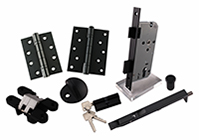
Soss hinges represent the gold standard for hidden door applications. These complex mechanisms completely disappear when the door closes, leaving no visible trace of hardware.
The unique design uses interconnected links that fold into mortises cut into both the door and frame. When properly installed, even close inspection reveals no hint of the hinge's presence.
Weight ratings vary by model, with heavy-duty Soss hinges supporting doors up to 180 pounds. Multiple hinges can be used together for heavier applications, though this increases installation complexity and cost.
Installation requirements demand precision and skill. You'll need to cut precise mortises in both the door and frame, and any measurement errors will prevent proper operation. Professional installation is often recommended for Soss hinges.
Cost considerations make Soss hinges a premium option. A single heavy-duty Soss hinge can cost $200 or more, and most doors require at least two hinges for proper support.
European hinges, commonly used in cabinet making, offer excellent adjustability and concealment for lighter hidden doors. These hinges mount inside the door frame and provide multiple adjustment points for perfect alignment.
Adjustment capabilities allow fine-tuning of door position even after installation. You can adjust the door up, down, in, out, and side to side without removing the hinge—a valuable feature for hidden doors that must align perfectly with surrounding surfaces.
Weight limitations restrict European hinges to lighter applications, typically under 40 pounds per hinge. This makes them suitable for hidden panels and lightweight secret doors but inadequate for heavy bookcase doors or armor-plated entrances.
Concealment quality depends on proper installation and door construction. When the door face is recessed slightly from the frame, these hinges remain completely hidden while still providing excellent functionality.

Pivot hinges mount at the top and bottom of the door rather than along the side edge. This design provides exceptional weight capacity and allows for unique concealment opportunities.
Load capacity represents the primary advantage of pivot hinges. Heavy-duty models can support doors weighing 500 pounds or more, making them suitable for the heaviest hidden door applications.
Concealment methods require creative approaches since pivot points must be accessible. Top pivots often hide in ceiling details or header trim, while bottom pivots can be concealed in floor recesses or threshold details.
Installation complexity varies depending on your specific application. Simple pivot hinges are straightforward to install, while adjustable models with concealed mounting require more sophisticated construction techniques.
Spring-loaded hinges automatically close your hidden door, eliminating the need to remember to secure your secret entrance. This feature proves invaluable for doors protecting valuables or providing security.
Closing force adjustment allows you to set the appropriate tension for your door weight and desired closing speed. Too little force won't close the door properly, while excessive tension makes opening difficult.
Safety considerations require careful adjustment to prevent the door from closing too forcefully. Fingers can be pinched, and the door may slam shut if spring tension is set too high.
Combined functionality means you can often get spring-loaded versions of other hinge types. Piano hinges, European hinges, and even some concealed models offer spring-loaded options.
Proper installation determines whether your hidden door operates smoothly for years or becomes a constant source of frustration. Start by ensuring your door frame is perfectly square and level—any irregularities will cause binding and uneven gaps.
Precise measurements cannot be overstated in importance. Measure twice and cut once applies especially to hidden door hinges, where mistakes often require starting over with new hardware or even rebuilding the door.
Test fitting should happen before final installation. Temporarily mount the hinges and test door operation before finalizing mounting screws or making irreversible cuts.
Quality fasteners ensure long-term reliability. Use screws specified by the hinge manufacturer and consider structural screws for heavy doors. The strongest hinge becomes useless if mounted with inadequate fasteners.
Consider your door's weight first—this eliminates options that cannot provide adequate support. Next, evaluate your concealment requirements and installation skill level.
For heavy doors requiring maximum concealment, Soss invisible hinges provide the best solution despite their higher cost and installation complexity. Piano hinges offer excellent value for doors where you can route concealment channels.
Budget-conscious projects with lighter doors benefit from European-style hinges, while extremely heavy doors may require pivot hinge systems.
Selecting the right hidden door hinge transforms your secret entrance from a problematic DIY project into a smooth-operating architectural feature. Consider your specific requirements carefully—door weight, concealment needs, budget, and installation complexity all play crucial roles in determining the best solution.
Remember that quality hardware represents an investment in long-term satisfaction. A properly chosen and installed hidden door hinge will provide years of reliable, silent operation while maintaining the mystery and functionality that makes hidden doors so appealing.