Views: 0 Author: Site Editor Publish Time: 2025-12-19 Origin: Site


When designing commercial or residential spaces, the smallest details often present the biggest challenges. You want the sleek, minimalist aesthetic that comes with flush doors and clean lines, but you also have strict safety regulations to navigate. This is where hidden hinges (also known as invisible or concealed hinges) come into play. But not all hinges are created equal, especially when fire safety is on the line.
Selecting the right hardware is about more than just aesthetics; it is a critical safety decision. If a hinge melts or deforms during a fire, the door fails, and the fire spreads. This is why CE compliance and fire ratings are non-negotiable for commercial projects.
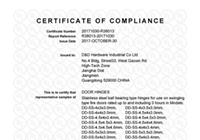
This article breaks down exactly which hidden hinges meet these rigorous standards, how to interpret the ratings, and what to look for when specifying hardware for your next project. We will explore the technical specifications of D&D Hardware’s compliant ranges to help you make an informed choice that satisfies both your design vision and the fire inspector.
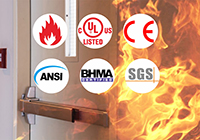
Before diving into specific product models, it is essential to understand the certifications that govern high-quality door hardware. Without these stamps of approval, a hinge is simply a mechanical part with no guarantee of performance under stress.
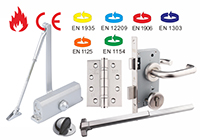
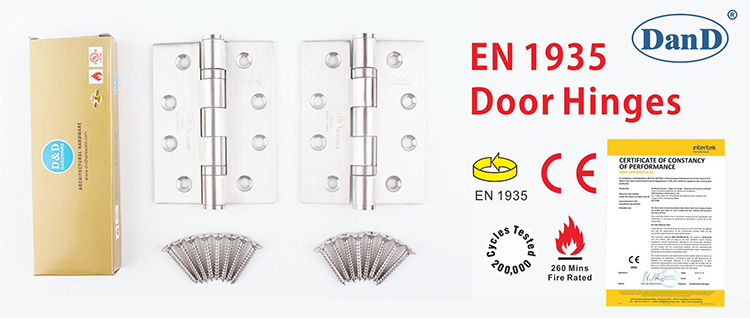
EN1935 is the European standard that specifies requirements for single-axis hinges. For a hinge to meet this standard, it must undergo rigorous testing regarding its durability, static load, and corrosion resistance.
When a hidden hinge is certified to EN1935, it means it has survived cycle testing (often up to 200,000 cycles), ensuring that the door will open and close smoothly for years without sagging or seizing. This is particularly vital for invisible hinges, which have complex internal mechanics compared to standard butt hinges.
This is the fire resistance test. EN1634 determines how long a door assembly (including the hinges) can withstand fire exposure while maintaining its integrity.
For a hidden hinge to be viable for fire doors, it typically needs to withstand fire for at least 30 minutes (FD30) or 60 minutes (FD60), though higher ratings exist. D&D Hardware’s hinges, for example, have been tested to withstand fire for up to 132 minutes, far exceeding the standard 60-minute requirement for most commercial applications.
To help you identify the right hinge for your specific application, we have compiled a comparison of key models that meet these rigorous safety standards. The table below details the specifications for D&D Hardware’s fire-rated and heavy-duty options.
Feature | EN1935 Heavy Duty Hinge | EN1634 Fire Rated 3D Hinge |
|---|---|---|
Primary Application | High-traffic internal doors | Fire-rated interior doors |
Fire Rating | N/A (Focus on load-bearing) | Up to 132 Minutes |
Cycle Test | 200,000 Cycles | 200,000 Cycles |
Material | Zinc Alloy / Stainless Steel | Zinc Alloy / Stainless Steel |
Adjustability | 3D Adjustable | 3D Adjustable |
Door Weight Capacity | Varies (40kg - 120kg+) | Varies (40kg - 120kg+) |
You might wonder why "3D Adjustability" is listed alongside safety features. In the context of fire doors, the gap between the door leaf and the frame is critical. If the gap is too wide, intumescent seals may not expand effectively to block smoke and fire.
3D adjustable hinges allow installers to tweak the door position in three directions:
Vertical (Height): +/- 2mm
Horizontal (Side): +/- 2mm
Depth (In/Out): +/- 2mm
This precision ensures that the door maintains the tight tolerances required for fire certification, even if the door leaf warps slightly over time or the frame isn't perfectly plumb.
Choosing the correct hardware involves balancing weight, usage, and environment. Here are the answers to the most common questions regarding compliant hidden hinges.
The two primary contenders are Stainless Steel and Zinc Alloy.
Stainless Steel: This is the superior choice for durability and corrosion resistance. If your project is in a coastal area or a sterile environment (like a hospital), stainless steel internal components are crucial.
Zinc Alloy: This material is excellent for the body of the hinge. It allows for precise casting, which is necessary for the complex mechanics of a 3D adjustable hinge.
D&D Hardware often utilizes a hybrid approach, using stainless steel for the load-bearing links and zinc alloy for the main housing to offer the best balance of strength and cost-effectiveness.
While two hinges might technically hold a lightweight door, the industry standard for fire doors is three hinges.
Hinge 1 & 2: Placed near the top of the door to carry the tensile load.
Hinge 3: Placed near the bottom to handle the compressive load.
Using three hinges helps prevent the door from warping during a fire event, which is essential for maintaining the fire seal. For extra heavy doors (over 120kg), a fourth hinge is often recommended.
Yes. There are specific models designed for metal doors versus wood doors.
Wood Door Hinges: typically use screws that bite into the timber.
Metal Door Hinges: often require machine screws or mounting brackets welded inside the hollow metal frame.
Refer to the table below for specific model suitability:
Door Type | Recommended Hinge Type | Key Installation Feature |
|---|---|---|
Wooden Fire Door | 3D Adjustable Zinc Alloy | Deep mortise flush installation |
Metal Security Door | Heavy Duty Hidden Hinge | Reinforced mounting plates |
Aluminum Frame | Stainless Steel Invisible Hinge | Narrow profile design |
To further clarify the capabilities and limitations of hidden hinges, we have answered some frequently asked questions below.
Yes, provided you choose the correct weight rating. Modern concealed hinges are engineered to carry significant loads. For example, a set of heavy-duty invisible hinges can easily support a 120kg door, which covers almost all standard commercial and residential applications. The key is to check the Load Capacity spec sheet before purchasing.
Absolutely. One of the main benefits of high-quality invisible hinges (like the 180 Degree Secret Hidden Hinge) is that they allow the door to swing open completely flat against the wall, provided there is no architrave obstruction. This is vital for hospital corridors or schools where doors need to be kept fully open to maintain clear traffic flow.
It is possible, but difficult. Concealed hinges require a deep mortise (a pocket cut into the door and frame). If the door was originally prepped for standard butt hinges, the holes will not match, and there likely won't be enough wood material left to securely fasten a hidden hinge. These are best specified for new doors or totally new frames.
While D&D hinges are tested for 200,000 cycles, fire doors should be inspected every 6 months.
Check for visible signs of metal wear or metal shavings.
Ensure the door closes fully and latches without assistance (the hinge shouldn't bind).
Check that the 3D adjustments haven't slipped and the gaps remain consistent.
Lubricate the pivot points with a suitable non-flammable lubricant if the manufacturer recommends it.
1
You no longer have to choose between a safe building and a beautiful one. With the advancements in engineering, hidden hinges now offer the robust fire protection (up to 132 minutes) and load-bearing capacity required for commercial architecture.
When selecting your hinges, always verify they carry the CE mark and have been tested to EN1935 and EN1634 standards. Whether you are outfitting a luxury hotel, a modern office, or a residential high-rise, choosing the right compliant hardware ensures that your clean, invisible design lines are backed by serious safety performance.
If you need assistance matching a specific door weight to a hinge model or require fire test reports for your building inspector, reach out to the specialists at D&D Hardware for guidance.