Views: 0 Author: Site Editor Publish Time: 2026-03-16 Origin: Site


A fire-rated door is only as effective as the hardware holding it together. Many building owners and contractors make the mistake of assuming that any standard door hardware will do the job—but that assumption can be costly, and in an emergency, dangerous.
Fire-rated doors are engineered to contain fire and smoke for a defined period, giving occupants time to evacuate safely. But that containment capability depends entirely on every component performing as designed. The hinges, locks, closers, and exit devices must all meet specific fire resistance standards. Install the wrong hardware, and the door's fire rating is effectively void.
This post breaks down exactly what hardware fire-rated doors require, why certification matters, and what to look for when specifying fire door hardware for metal doors or other fire-rated assemblies.
Standard door hardware is tested for everyday mechanical performance—durability, load capacity, and smooth operation. Fire-rated door hardware must pass all of that and demonstrate it can maintain its structural integrity under extreme heat for a set duration.
Hardware used on fire-rated doors is tested according to recognized international standards, including:
UL 10C – Positive Pressure Fire Tests of Door Assemblies (United States)
BS EN 1634 – Fire resistance tests for door assemblies (Europe/UK)
ANSI/BHMA – American National Standards for various hardware types
1
Each component category has its own standard. Hinges, for instance, are tested under ANSI/BHMA A156.1 and UL 10C (for butt hinges) or EN 1935 (for European-style hinges). Door closers fall under UL 228 and EN 1154. Panic exit devices are evaluated against ANSI/UL 305 and EN 1125. The point is: fire door hardware isn't a single category—it's a system, and every piece of that system must be listed or certified independently.
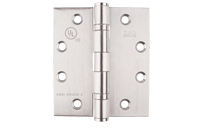
Hinges are arguably the most structurally critical component on any door. On a fire-rated assembly, they need to hold the door in position even as surrounding materials warp or expand under heat.
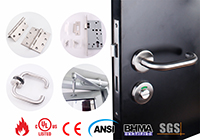
Fire rated door hinges are typically manufactured from stainless steel (SUS 304, 316, or equivalent) and must pass fire resistance tests at specified durations. For example, hinges compliant with EN 1935 and EN 1634 are tested up to 260 minutes, while UL-listed fire rated hinges are rated for up to 3 hours. Steel bearing-type hinges are required for fire door assemblies—plain steel non-bearing hinges are only permissible if they are part of a listed assembly.
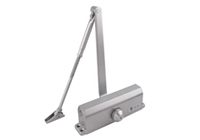
Every fire door must be self-closing. That requirement alone makes a certified door closer non-negotiable. A fire rated door closer ensures the door returns fully to the latched position after use, preventing fire and smoke from passing through.
Door closers for fire-rated applications are tested under UL 10C and EN 1154, with fire ratings commonly reaching 120 minutes (EN) or 3 hours (UL). They are typically constructed from aluminum alloy and come in overhead, concealed, or slide-channel configurations to suit different door types and architectural requirements.
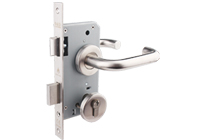
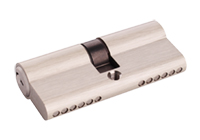
A fire door must be self-latching. This is a basic compliance requirement under NFPA 80, and it means any lock used on a fire door must include a functioning latch bolt—not just a deadbolt alone.
Fire door locks are tested under UL 10C (up to 3 hours) and EN 12209/EN 1634 (up to 260 minutes). For metal door applications, mortise locks in stainless steel 304 are the common choice, offering both fire resistance and corrosion resistance. Lock types vary widely depending on the door's function: passage locks, classroom locks, deadbolts, and privacy locks are all available in fire-rated configurations.
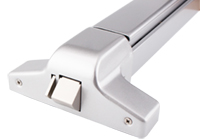
In means-of-egress applications—stairwells, corridors, exit routes—fire doors typically require panic exit hardware. These devices allow the door to be opened quickly under emergency conditions by pressing a bar across the width of the door.
Fire rated panic exit devices, also called fire exit hardware, must pass both panic and fire compliance tests. Products certified to ANSI/UL 305 and UL 10C (up to 3 hours), or EN 1125 and EN 1634 (up to 240 minutes), are required in these locations. They are available in rim, mortise, vertical rod, and concealed vertical rod configurations for single and double door openings.
Beyond standard butt hinges, concealed fire rated hinges are used in applications where aesthetics are a priority—hotels, offices, and institutional buildings often specify them. These 3D adjustable concealed hinges can be certified to EN 1935 and EN 1634 for fire ratings up to 132 minutes or more, depending on the door weight capacity (typically available for doors ranging from 40 kg to 120 kg).

Metal fire doors—steel or hollow metal doors—are common in commercial and industrial settings. They offer excellent inherent fire resistance, but the hardware specified for them must still carry appropriate listings for metal door assemblies specifically.
Not all fire rated hardware is tested for use on both wood and metal doors. When specifying fire rated door hardware for metal doors, confirm that the product's UL or EN listing explicitly covers steel door assemblies. Some hardware is tested and listed for wood, metal, and composite door types—these are the most versatile options for large-scale projects.
Additionally, door hardware for metal doors must be installed with appropriate steel bearing hinges. The NFPA 80 standard is explicit: fire doors require steel bearing-type hinges, and the assembly must be labeled and maintained accordingly.
Proper fire door hardware installation isn't just best practice—it's a legal requirement in most jurisdictions. NFPA 80 governs the installation, inspection, testing, and maintenance of fire door assemblies in the United States. European projects follow EN 1634-1 and related standards under CE marking requirements.
Key compliance checkpoints include:
The door must have a fire rating label — and so must the frame
All hardware must be listed for use on fire-rated assemblies
The door must be self-latching and self-closing at all times
No obstructions (wedge stops, hook backs, chains) may prevent proper door operation
Glass panels in fire doors must use labeled wire glass or approved fire-rated glazing
Fusible link louvers are subject to strict size and placement limitations
Only listed fire door hardware shall be used—this is a direct requirement under NFPA 80, not a suggestion.
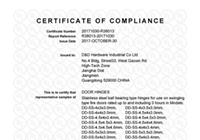
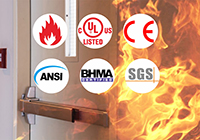
When specifying fire door hardware, the reliability of your supplier matters as much as the product specifications. Look for manufacturers who hold independent third-party certifications—UL listings, CE markings, and ANSI/BHMA compliance should all be verifiable through official certification bodies.
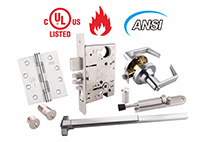
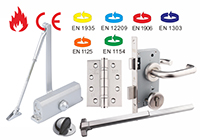
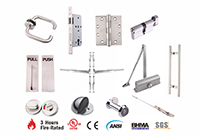
D&D Hardware (danddhardware.com) is one manufacturer that produces a comprehensive range of certified fire door hardware, including hinges, locks, door closers, panic exit devices, and handles tested to both UL 10C and BS EN 1634 standards. Their products cover ANSI, CE, and UL requirements, making them suitable for projects in North America, Europe, and beyond.
Fire rated door hardware is not an area where substitutions or shortcuts are acceptable. Every component in a fire door assembly—hinges, closers, locks, and exit devices—must be independently certified and installed as part of a compliant assembly.
For architects, contractors, and facility managers specifying hardware for new builds or retrofits, the guidance is straightforward: confirm the listing, check that the hardware is appropriate for your door type (metal, wood, or composite), and ensure the full assembly meets the applicable standard for your jurisdiction.
When in doubt, work with a supplier who can provide documentation for each product and support your compliance review. Fire door performance in an emergency depends on every decision made well before that emergency occurs.
Explore D&D Hardware's full range of certified fire rated door hardware at danddhardware.com/fire-rated-door-hardwares.html.